

There is a version of this review that says the chews turned the clock back and the dog is running again. I am not going to write that one. Hattie is ten years old, she has arthritis in both hips, worse on the left, and nothing that comes out of a container has reversed that. What I can tell you is that she has had VetIQ Maximum Strength Hip & Joint chews on top of her breakfast every morning since October 2024, and that I have kept a line a day on a clipboard since the week we started. That clipboard is the reason I am writing this, because it records a few things the product listing does not say and a few things the enthusiastic reviews leave out.
The short version first. Of the five things Hattie takes, this is the one I would replace last. Not because it did something dramatic. Because the change I could actually point to on paper arrived inside eight weeks and then held, and I cannot say that about all of them. What follows is the long version: what the label really lists, what the first two months looked like, the parts that never improved, and the one thing about the serving size that took me an embarrassingly long time to work out.
The Quick Verdict
A plain, well-made glucosamine chew that produced one modest change I could measure and several it could not. Worth trying with a vet in the loop, not worth treating as a painkiller.
Amazon Check Today's Price →Three Chews a Day, and a Clipboard to Prove It
VetIQ Maximum Strength Hip & Joint, 180 soft chews, chicken flavor, with glucosamine, fish oil and krill on the panel. At three chews a day for a 68 pound dog, one container runs about two months.
Amazon Check Today's Price on Amazon →How I Have Used It
Hattie started on these in October 2024, after Dr. Amsel looked at the X-rays from September and suggested a glucosamine product before we talked about anything stronger. I read the container to him over the phone, line by line, before she had her first one. The serving for her weight is three soft chews a day. There is a loading suggestion on the label for the first stretch, and I skipped it and went straight to the regular serving. That was my choice, not his instruction, and I told him I was doing it.
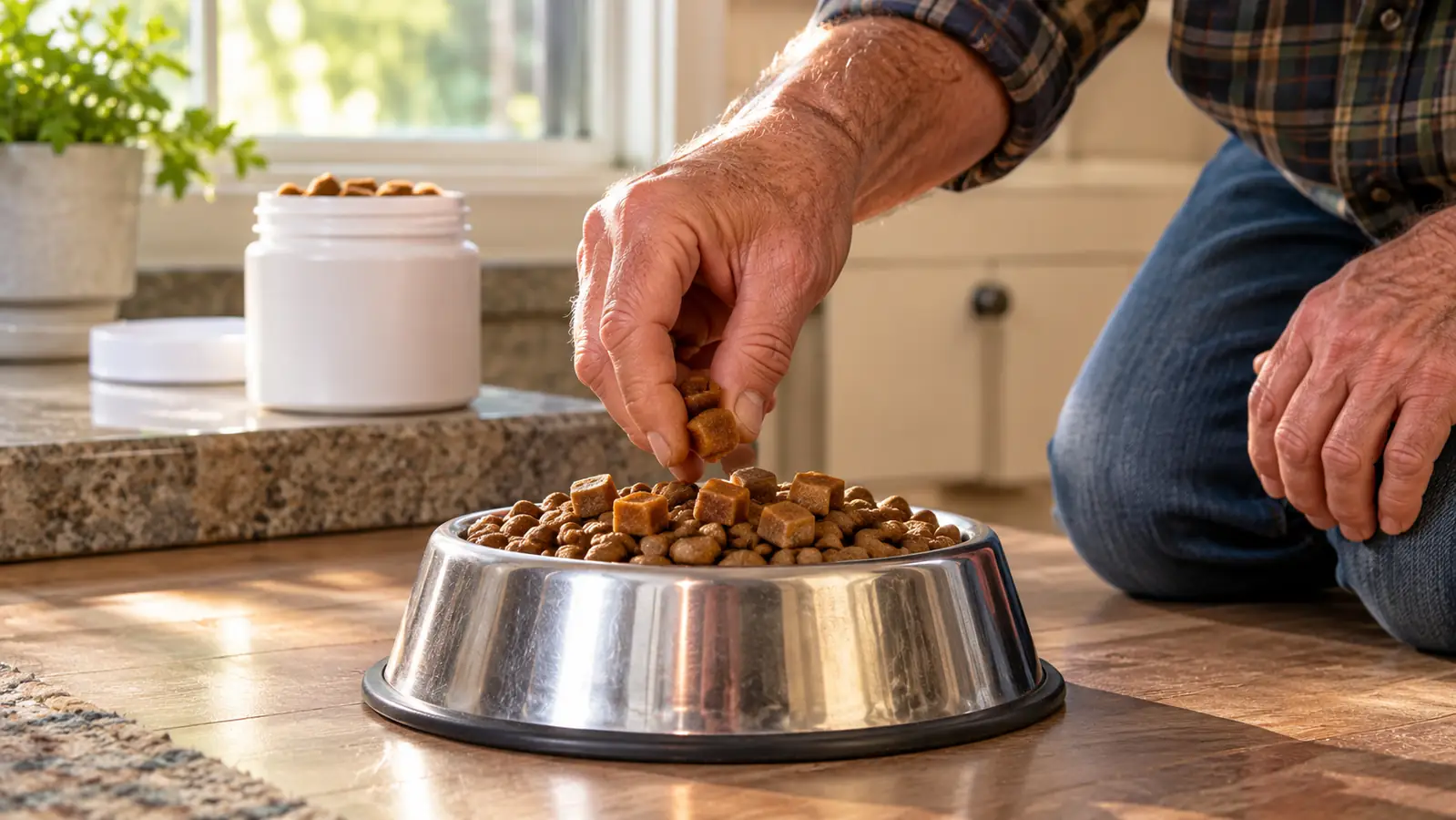
The method has not changed in two years. Three VetIQ chews, set on top of the kibble at seven in the morning, not crumbled and not hidden in anything. She eats them before she touches the rest of the bowl, which tells you something about the chicken flavor. I give them most days. Dan handles breakfast now and then when I am out, and I leave the count on the clipboard so he does not have to guess. Two years in, the only part of the routine that has changed is that I no longer think about it, which is the highest compliment I can pay something that has to be given every single day.
One thing I did on purpose. I added her supplements one at a time, months apart, so the clipboard had a chance to show something before the next thing muddied the water. That was the coach in me, not the dog owner.
I am not a vet and I am not going to write like one. Thirty-one years of coaching cross country taught me to watch how a body moves and to write down what I saw instead of what I hoped for. That is the whole of my expertise here. Everything below is one dog, one household and a log. If your dog is limping, that is a vet visit, not a shopping decision.
What the Label Actually Says
The panel on the VetIQ container leads with glucosamine HCL at 600 mg per chew, fish oil at 280 mg and krill at 210 mg, and MSM is right there in the product name on the front. The chews are chicken flavored and soft, and the container holds 180 of them, listed at 1.42 pounds and about 3 by 7.1 by 9 inches, which means it sits on the pantry shelf beside the flour without needing a shelf of its own. That is the whole of what I can tell you from the outside of the container. It is also more than most reviews bother to repeat.
MSM is named on the front and it appears on the panel alongside the glucosamine, the fish oil and the krill. I cannot give you a milligram figure for it from the part of the listing I can read, and I am not going to invent one to make a paragraph look thorough. What I can tell you is that Dr. Amsel read the panel before she started, knew exactly what was in it, and was comfortable with us beginning there. That is a better endorsement than anything I could write from my kitchen.
Here is the part nobody puts in the headline. There is no chondroitin on that panel. If you have been reading about joint supplements, you have seen chondroitin paired with glucosamine so often that you probably assume it is in here. It is not. That does not make this a bad product. It makes it a glucosamine product with fish oil, krill and MSM, and if you specifically want chondroitin in the mix, you will need to read panels rather than trust a photograph of a happy dog on a label.
The other thing worth knowing is what the container does not promise. It is listed for joint health, and the smaller print mentions skin and coat and digestive support, which is normal for anything with fish oil in it. Nowhere does it claim to be a pain reliever, and I would be careful with a glucosamine product that did. Hattie is not on pain medication. That was discussed last year and set aside for later, and these chews were never presented to me as a way around that conversation.
One question I did put to Dr. Amsel was whether the fish oil and krill in these chews overlapped with the salmon oil Hattie gets at dinner. He said the amounts were small enough that it did not change the plan, and to keep the two meals separate, which is why this goes at breakfast and the oil goes at dinner. If your dog is already on an oil, that is worth asking out loud rather than assuming.
The First Eight Weeks, Straight Off the Clipboard
October and November were quiet, and I want to be honest about that, because it is where a lot of people quit. The clipboard for those weeks looks almost identical to the clipboard from September. Up in the morning, some hesitation, out to the deck, down the four wooden steps to the yard, walk, home. I could not point to a single thing that had changed, and I said so to Dan more than once. My note at the end of the sixth week was three words: no real change.
The second week of December is where the writing changes. The line reads that she got up off the living room carpet in the morning without the pause. Not faster, not springy. The pause was gone. I noticed it on a Tuesday, then noticed it again on Wednesday, and by the end of that week I had stopped holding my breath every time she stood. That is a small thing to read back in a sentence. If you have watched a big dog think about standing up, you know it is not small at all.
I want to be careful with that, because a person watching for improvement will find it whether or not it is there. That is exactly why the clipboard earns its place on the counter. Nine mornings in a row saying the same thing is harder to argue with than a feeling. Six to eight weeks was the window, it matched what Dr. Amsel said to expect if it was going to work at all, and it held through the winter instead of fading out by February.
The second week of December 2024 is where the handwriting changes: up off the carpet, no pause. Same dog, same floor, same morning.
What Did Not Change
Plenty did not change, and this is the section the five star reviews skip. Going up the four steps to the deck is still slow. Down is steady now, up is a different story, and it has stayed that way. Cold, wet mornings are still her worst, and there are days in January when she stands at the bottom of those steps and thinks it over before she commits. Nothing in a chew has touched that.
She does not run. She has not jumped into the back of the Outback since 2024 and she has not started again; Dan still lifts her back end in, and no product changed that. She is not young again and she is not pain free. If you are reading this hoping for a container that undoes a diagnosis, I would rather disappoint you here than have you spend two months watching your own dog and then feel like you failed at it.
The walk is longer than it was, about 25 minutes on the rail trail against 15 in September 2024, and steady at that for a year now. I cannot hand that to this container. Five things went into her over eighteen months and the walk came back gradually across all of it. What I can say is that the walk did not shrink again while she was on these, and it had been shrinking all through the year before we started.

What I Cannot Prove, and Why I Still Keep It
Here is the honest accounting. Hattie takes five things, added months apart, and none of them was ever stopped to test the others. I cannot tell you what share of her good morning belongs to the glucosamine and what share belongs to the mussel powder, or the hyaluronic acid, or simply to a dog who kept moving and stayed at 68 pounds. Anyone who tells you they can separate that out in a house with one dog and no washout period is selling you something.
What I can tell you is the order I would do it in again. This is the one I would start with, and the one I would fight to keep if the budget got tight. Not because the change was large. Because it was first, it was measurable, and it landed inside the window the vet named before we began. That is about the most a supplement can offer you before you have spent two years guessing.
The other reason is the container itself. 180 chews at three a day is sixty days, so the reorder rhythm is predictable and I am not counting chews on a Sunday night wondering whether we make it to Tuesday. Soft chews, chicken flavor, no crumbling, no mixing, no coaxing. Two years in, she still takes them off the top of the bowl before the kibble. Convenience is not a medical result, but it is the reason a lot of people quit a supplement in month one and never find out whether it would have worked.
The Boring Logistics That Decide Whether You Stick With It
Storage is the pantry shelf, lid on, and the VetIQ container has lived there through two summers without going sticky or clumping. It is 1.42 pounds and roughly 3 by 7.1 by 9 inches, so it stacks behind the cereal and does not need a dedicated spot. I write the start date on the lid in marker, which is a habit left over from coaching, and it means I always know where I am in the sixty days without opening a calendar.
One caution on serving. Three chews a day is a heavier serving than some products use, so a container that looks large empties faster than you expect. If your dog is smaller than Hattie the serving comes down and the container stretches further. If your dog is larger, the reverse. Read the serving for your dog's weight on the container before you decide how the numbers compare, because a container with a lighter serving is not automatically the better buy over sixty days.
And the flavor matters more than it sounds. I have had a dog turn her nose up at a chew, and then I have had a container going stale in the pantry while I pretended it would get better. This one she takes dry, from a bowl, in under a minute. If your dog is fussy, that is the first thing to test, not the last.
What I Liked
- Glucosamine at 600 mg per chew with fish oil and krill on the same panel
- Soft chicken chew that a 68 pound dog takes off the top of the bowl with no coaxing
- 180 chews at three a day works out to about two months per container
- The one change I could point to arrived between six and eight weeks and held through winter
Where It Falls Short
- No chondroitin on the panel, which surprises people coming from other joint products
- Three chews a day is a heavier serving than some competing products use
- Going up the deck steps is still slow after two years
- It is not a pain reliever, and it will not get a stiff dog off the carpet on a wet January morning
Who This Is For
This suits an older dog with a diagnosis rather than a hunch, and an owner willing to give it eight weeks before deciding anything. It suits a household where the dog is already on decent food and at a sensible weight, because none of this works as a substitute for that. Dr. Amsel asked us to keep Hattie under 70 pounds, she has stayed at 68, and I do not think the chews would have shown me anything if we had let that slide.
It also suits the person who wants one thing to start with. If you are staring at a wall of joint products and cannot tell them apart, VetIQ is a reasonable first container: a named ingredient panel, a clear serving, a large review count behind it, and a vet willing to read the label with you. Dr. Amsel's only condition was that we stop and reassess if nothing showed by eight weeks.
Who Should Skip It
Skip it if your dog is limping, holding a leg up, or has gone off her food. That is not a supplement problem and two months of chews will not solve it. Skip it if you want chondroitin in the formula, because it is not here. Skip it if you are not going to be consistent, since three chews most days but not all days tells you nothing either way, and you will have spent sixty days to learn nothing.
And skip it if you are expecting the dog you had five years ago. Hattie is not that dog and she is not going to be. What I have is a ten year old golden who gets up easier than she did in September 2024, walks about 25 minutes, comes down the deck steps steadily and is still slow going up. That is what two years of honest notes looks like, and it is worth having. It is just not the story printed on the front of the container.
The Container I Would Buy Again, Knowing What I Know
180 soft chews, chicken flavor, three a day at Hattie's weight. Give it eight weeks, keep a line a day on something, and let your own notes decide instead of mine.
Amazon Check Today's Price on Amazon →