

I started VetIQ Maximum Strength Hip & Joint in October 2024, on Dr. Amsel's suggestion, about a month after he put Hattie's hips on an X-ray and called it arthritis in both, worse on the left. Hattie is a 10-year-old golden retriever, 68 pounds. She is the only dog in the house. I am 61, a retired PE teacher and cross country coach, and I am not a veterinarian. What I have is a clipboard on the kitchen counter, one line a day: how she got up, how she did on the four wooden steps off the back deck, how far we walked. That is the whole basis for this review.
I did not buy five joint products at once. I added them one at a time, months apart, because I wanted the clipboard to have a chance to show something. VetIQ was first. It is the only one I can say seemed to work first, and even that comes with a caveat I will repeat more than once: because the other four came later and overlap, I cannot prove which product did what. Anyone who tells you a chew fixed a dog is selling something. Dr. Amsel looked at every label before Hattie started. No surgery, no injections, no prescription pain medication. That was discussed as something to revisit later, and she is not on it. Your vet conversation should start with your vet, not with me.
The Quick Verdict
It did one modest thing well: Hattie gets up from the floor with less hesitation. It did not make her young, and I still cannot prove which of her five supplements did what.
Amazon Check Today's Price →The first chew I added, and the one I still measure the others against
VetIQ Maximum Strength Hip & Joint is a soft chew with 600 mg glucosamine HCL, 280 mg fish oil and 210 mg krill on the label, plus MSM in the product name. At Hattie's weight it is three chews a day, set on top of breakfast. It did not make her young. It did make the morning floor-to-stand line on my clipboard look better by December 2024.
Amazon Check Today's Price on Amazon →How I've Used It
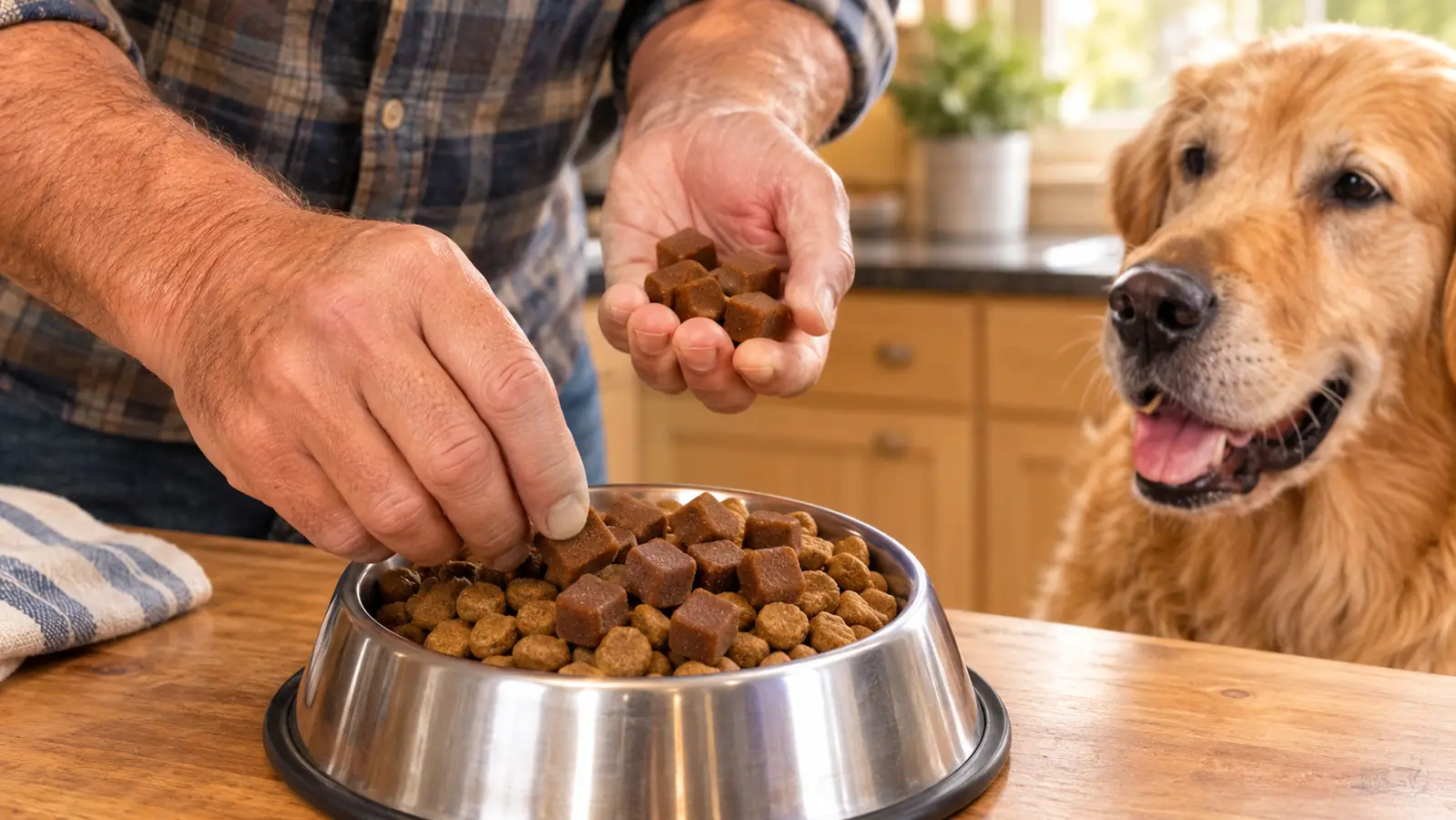
Hattie gets three chews a day at 68 pounds, not the doubled starting amount some containers suggest. I skipped that. I put them on top of her breakfast kibble at 7, and she eats them first, which tells you the chicken flavor is not a problem. The container holds 180 soft chews, so at three a day it runs about two months. I keep it in the pantry.
I started in October 2024. For the first six weeks I did not see much. I want to be plain about that, because the temptation with a senior dog is to see what you hope for. The clipboard line that changed first was the morning one. By December 2024 she got up from the floor with less hesitation. Not a jump. Not a run. Less of that pause where she would gather herself and then push.
We are now two years in, November 2026, and she is still on it. Three chews a day, every morning, except the occasional meal Dan handles when I am out. He knows the drill. The container sits in the pantry next to the turmeric. I have never stopped it to test what happens without it, and I would not, because she is 10 and I am not running experiments on her comfort just to satisfy my curiosity.
I have never had a bad reaction to report. No loose stool, no vomiting, no refusal to eat. I know that is the first question people ask about any joint product. I watched for it for the first two weeks and then I stopped watching, because nothing happened. That is not proof it is gentle for every dog. It is one dog, one owner, one clipboard.
What Is in the Container
Label facts first, because this is where I trust the print over the marketing. The label lists 600 mg glucosamine HCL from shellfish, 280 mg fish oil and 210 mg krill. The product name says MSM, and that is on the container. The form is a soft chew, chicken flavor, 180 count. The container is listed at 1.4 pounds. That is what I can verify. I am not going to pretend I know how every milligram behaves in a 10-year-old dog.
One thing I appreciate: I can read the label. I have picked up joint products in the feed store that list a proprietary blend and a picture of a dog running through a field, and no real numbers. VetIQ puts the glucosamine amount in plain sight. That does not make it better than every other product. It makes it easier for Dr. Amsel to look at and easier for me to compare when I read the others.
The chews are soft enough to break if I need to, and Hattie has never turned her nose up at them. For a dog that has become picky about pills, that matters more than a fancy label. The container is not fancy. It is a container. It sits in the pantry and I open it twice a day.
I also checked the serving against her weight before I started, because the container gives a range and I am not going to guess with a 10-year-old dog. At 68 pounds she lands at three chews a day. If your dog is smaller, the label will put you at a lower amount. If your dog is larger, it may be more. Read the container. Do not copy my number just because it is on the internet.
What Changed and What Did Not
Changed: the morning stand. In September 2024 she would push up from the floor in stages. By December she still pushed, but the pause was shorter. That is the one line I would point to if you asked me what VetIQ did.
Changed: the deck steps down. She goes down the four wooden steps off the back deck more steadily than she did two years ago. I cannot give VetIQ all the credit. The salmon oil came in January 2025, the green lipped mussel in April 2025, the hyaluronic acid in August 2025, the turmeric in January 2026. They all overlap. If you want a clean answer, I do not have one.
Did not change: the steps up. She is still slow coming up those four steps. She still takes them one at a time, and I still wait. No product has fixed that. If a review tells you a chew fixed going up stairs in an arthritic 10-year-old dog, close the tab.
Did not change: the car. She stopped jumping into the Subaru Outback in 2024 and never started again. Dan lifts her back end in. No chew, no oil, no powder changed that. I am not going to pretend otherwise. She rides in the cargo area and she is fine once she is in.
Cold, wet mornings are still her worst. I noticed that in the log before I noticed it in my head. On a damp day in late fall she takes longer to get going, and the first few steps on the rail trail are stiff. VetIQ did not change the weather. It did not change the arthritis. It changed one part of the morning, and I will take it.
The Log Does Not Lie
I am a coach by trade, or I was for 31 years. I do not trust my memory on a dog's bad day, because a bad day is memorable and a good day is not. The clipboard is the only reason I can write this without guessing. One line a day. How she got up. How she did on the deck steps. How far we walked.
The walk numbers are the easiest to check. Years ago we did about 45 minutes on the rail trail. By September 2024 we were down to about 15. By summer 2025 we were back to about 25, and we have stayed there. I do not credit one product for that. I credit the routine, the weight, and five things that may each be doing a little. VetIQ is one of the five.
Her weight has stayed at 68 pounds. Dr. Amsel asked us to keep her under 70, and we have. That is not a supplement. That is breakfast at 7, dinner at 5, plain dry kibble, and not a lot of table scraps. I mention it because every joint product works better on a dog that is not carrying extra weight, and no container of chews changes that.

Where VetIQ Fits in a Five-Product Routine
Breakfast is VetIQ and the hyaluronic acid. Dinner is the salmon oil, the green lipped mussel powder and the turmeric. That is the schedule. It sounds like a lot when I write it out. It is a lot. I added them one at a time because I wanted to know if each one was worth the trouble, and the honest answer is that I only got a clear enough signal on the first one to say anything strong.
VetIQ is the one I would keep if I had to cut back to one. That is not a lab result. It is a coach's read on her own dog. It was first, it was the one Dr. Amsel suggested, and the morning stand changed while she was on it alone. That is the whole case. The other four came later, and I am not going to reverse engineer credit for them.
The label overlap is real. VetIQ has fish oil and krill. The salmon oil is fish oil. The green lipped mussel is shellfish, and so is the glucosamine source. I am not a vet and I am not going to tell you how to stack that. Dr. Amsel looked at every label before she started each one. If you are already giving three joint products, bring the containers to your vet and let them do the math.
I know people want a ranking. I am not going to give one. The products went in one at a time, months apart, and each one overlapped with the ones before it. If I told you the green lipped mussel was the best, I would be guessing. If I told you the turmeric was the best, I would be guessing. The only honest ranking I have is the order I added them, and VetIQ is first because it was first.
What I Liked
- Readable amounts on the label: 600 mg glucosamine HCL, 280 mg fish oil, 210 mg krill
- Soft chew with chicken flavor that Hattie takes without fuss
- 180 chews lasts about two months at three chews a day
- One mild change showed up on my clipboard by December 2024: less hesitation getting up from the floor
Where It Falls Short
- Three chews a day is a real commitment for a 68 pound dog
- The container runs out about every two months, so it is a repeat purchase
- I cannot separate its effect from the other four products Hattie takes
- It did nothing for the steps up or for jumping into the car
By December 2024, six to eight weeks in, the clipboard line that changed was the morning one: she got up from the floor with less hesitation. That is the whole claim I can make.
Who This Is For
This is for the owner of a large senior dog who has watched the morning stand get slower and wants a plain glucosamine chew with readable amounts. It is for someone who will give it daily for two months before deciding. It is for someone who already has a vet looking at the labels and who understands that a soft chew is support, not a cure.
It is also for the person who wants a container that lasts. At three chews a day, 180 chews is about two months. That is a predictable repeat purchase, not a one-week sample. If that sounds like too much commitment, this is not the product for you.
Who Should Skip It
Skip it if you want a single product to fix a dog that is already lame, or if you are not going to give it every day. Skip it if your dog has a shellfish allergy and your vet has not cleared the glucosamine source. Skip it if you are looking for a pain medication. This is not that, and I would not pretend it is.
Skip it if you cannot keep a simple record. Without the clipboard I would be telling you a feeling. With the clipboard I can tell you the morning stand changed by December 2024 and the steps up did not. That is a smaller story than a headline, but it is the true one. Hattie is not cured, not young again, and no product made her run or jump. She is easier to live with in one specific way, and that is enough for me to keep buying it.
If your dog is at the age where the morning stand tells the story, start with the one I started with
VetIQ Maximum Strength Hip & Joint, 180 soft chews, chicken flavor, three chews a day at Hattie's weight. It did one modest thing for her, and two years later I still buy it. Bring the label to your vet and keep your own log. That is the advice I would give you at my kitchen table.
Amazon Check Today's Price on Amazon →