
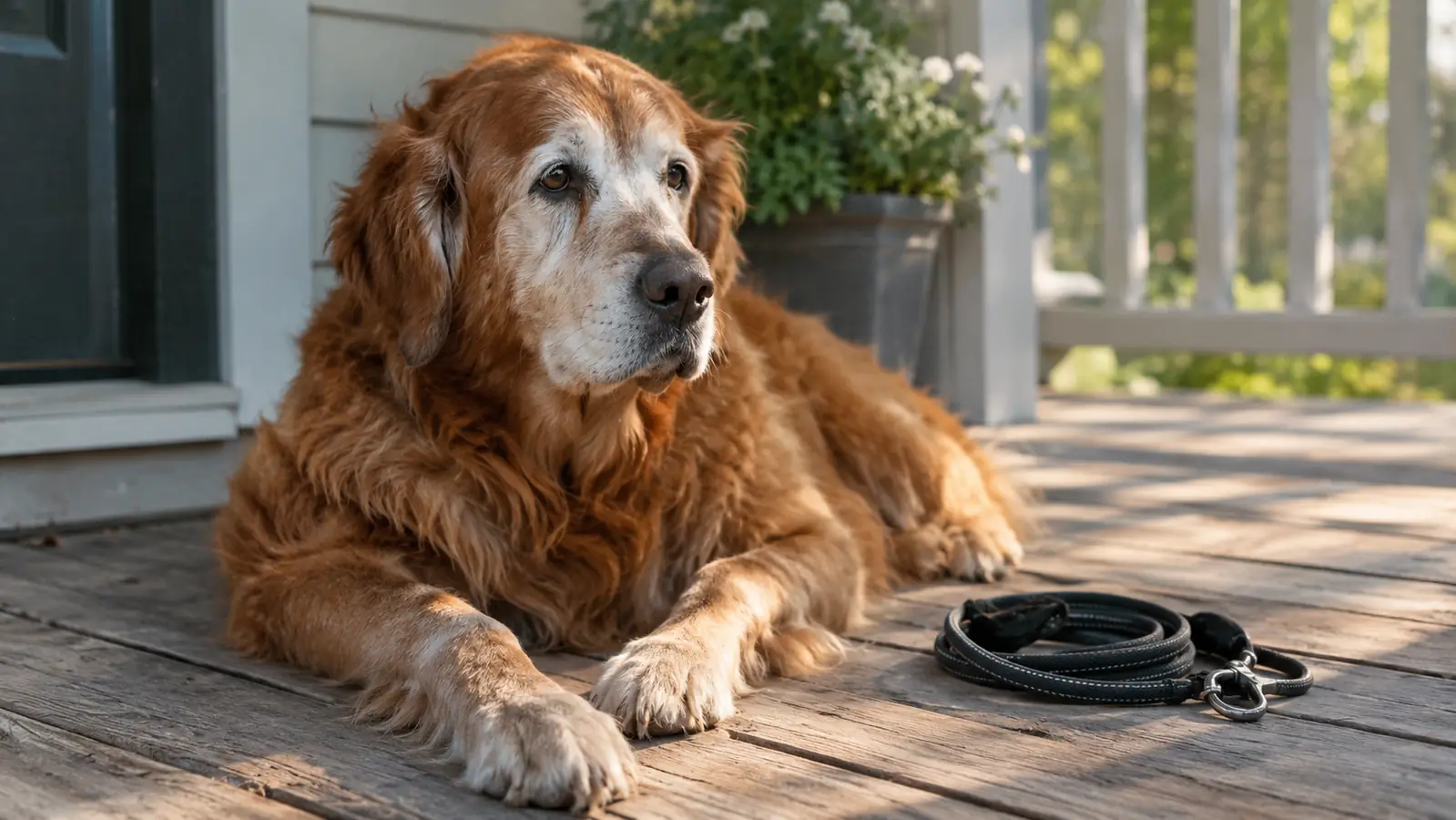
The first time I saw Hattie think about getting up, I was standing in the kitchen with a cup of coffee in my hand. She was on the carpet in the living room, front legs planted, back end not cooperating. She did not yelp. She just waited, looked at the floor, and tried again. I had watched kids run cross country for 31 years. I know a body that is guarding something when I see one. Hattie was 10, 68 pounds, and had been slowing down for months. That morning made it plain.
I am not a veterinarian. I am a retired high school PE teacher and coach, and my only qualification here is that I kept a clipboard on the kitchen counter and wrote down what I saw every day. Dr. Amsel, Hattie's vet since she was a puppy, took X-rays in September 2024 and found arthritis in both hips, worse on the left. We talked about surgery, injections and prescription pain medication. We decided to revisit those later. She is not on any of them. What we did try, on his suggestion, was VetIQ Maximum Strength Hip and Joint soft chews. That was October 2024. This is what I would tell another owner who is where I was that morning.
Before You Buy a Joint Chew, Get the Hips on a Screen
Hattie's X-rays told us what we were dealing with. A vet can tell you whether your dog needs something more than a supplement. Once that is settled, VetIQ is the chew I have used for two years and the one I still buy.
Amazon Check Today's Price on Amazon →Step 1: Get a Diagnosis Before You Buy Anything
A stiff dog is not a label. It is a symptom. The same slow rise from the floor can come from arthritis, a soft tissue strain, a neurological issue, or something else entirely. I wanted a name for what was wrong before I spent a dime on a supplement. Dr. Amsel examined Hattie, watched her walk, and took X-rays. That is how we learned the left hip was worse than the right.
The diagnosis also gave us a baseline. On the day of that visit, Hattie took a few seconds to get up from the floor, paused at the top of the four wooden steps off the back deck, and turned back early on the rail trail. I wrote those three things on the clipboard. Without that line, I would have had nothing to compare against two months later except my own hopes.
I am not saying every stiff dog needs the same workup. I am saying you should not guess. Ask your vet what is actually wrong, what to watch for, and whether a joint supplement is reasonable alongside the plan. Dr. Amsel was clear that a chew was not a cure and not a substitute for the conversation. That honesty is why I trusted the next step.
One thing I would do differently about that visit: I would have asked him to watch her do the thing I was actually worried about. He saw her walk on a flat floor in a small exam room. He did not see her get up off the carpet at home after a long nap, which was the whole problem. I described it to him, and he took me at my word, and the X-rays backed it up. But if your dog is worse at something specific, say so out loud, or take a short video on your phone and bring it. It took me a month to think of that, and it would have saved some guessing.
Step 2: Pick One Glucosamine Chew and Read the Whole Label
The container matters less than what is in it. I stood in the aisle with my phone and read labels until my eyes crossed. I wanted a soft chew, because Hattie is not a dog who will take a pill wrapped in cheese and pretend it is a treat. I wanted a chicken flavor, because she is a retriever and flavor is not a small detail. I wanted a count that would last, not a six-day sample.
The VetIQ container says 180 soft chews. The label lists glucosamine HCL at 600 mg, fish oil at 280 mg, and krill at 210 mg. The product title also names MSM and krill. I am not going to tell you it has chondroitin, because it does not. Dr. Amsel looked at the label before Hattie started it. That was not a ceremonial step. He checked the ingredients against her history and told me it was fine to try.
I picked one product and one product only. That was deliberate. If I had started three things in the same week, I would have had no idea which one mattered. The VetIQ chew was the first thing we tried, and it is the only product I will credit with being first. Everything else came months later, one at a time, so the clipboard had a chance to show something.
What I got wrong in the aisle, twice, was assuming the front of the container told me anything. The front is a picture and a word like maximum. The back is where the amounts live. The first container I picked up did not list glucosamine at all on the panel I could read, and I put it back. The second one listed it but in a form I did not recognize and could not compare to anything. By the third I had a rule: find the milligrams, find the serving size, then do the arithmetic on how long the container actually lasts. That third step is the one people skip, and it is the one that tells you whether you are buying a month or a week.
Step 3: Serve the Right Amount at the Same Time Every Day
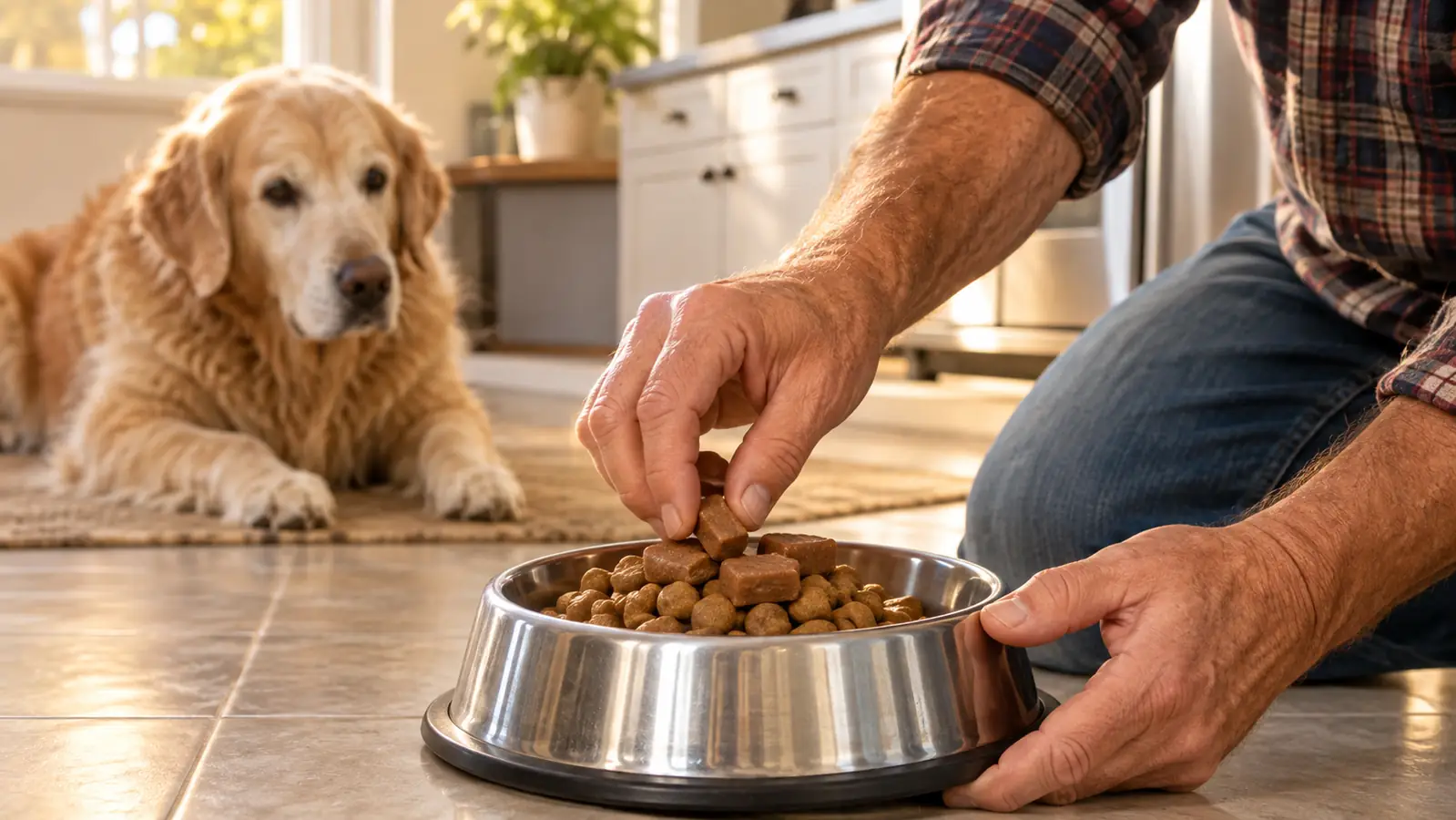
At 68 pounds, Hattie's serving was three chews a day. Dr. Amsel set that amount. I put them on top of her breakfast at 7 in the morning, every morning, and I did not turn it into a negotiation. She gets plain dry kibble, breakfast at 7 and dinner at 5. The chews go on the morning bowl. That is it.
I skipped the doubled starting amount that some joint products suggest for the first few weeks. I gave her the regular amount from day one. I am not saying that is the only way. I am saying it is what we did, and Hattie had no stomach trouble from it. The container lasted about two months at three chews a day. I kept it in the pantry and wrote the start date on the lid with a marker.
The routine matters as much as the chew. Same time, same bowl, same person most mornings. Dan handles a meal now and then when I am out, and he knows the drill. If you are splitting the feeding between two people, put the serving in writing. A dog who gets three chews one day and six the next is not on a routine. That is just guesswork with a scoop.
The soft chew is also, frankly, the reason this worked for us at all. Hattie is a dog who will eat around anything she does not like and leave it in the bowl with a look. She has done it with pills, and she has done it with a powder I tried stirring into her food once. The chew she takes off the top of the kibble without a pause. If your dog is a bowl inspector, that is worth more than any difference in the numbers on the label, because a supplement the dog refuses is a supplement with no effect. Three chews at 68 pounds also means the arithmetic is easy: one container, six chews a day for a smaller dog, three for mine, and you can see the two-month window from the count on the front.
Step 4: Give It Six to Eight Weeks and Write Down What You See
I did not expect a change in a week. I have watched enough bodies heal to know that joints are slow. I gave it six to eight weeks before I formed an opinion. Every morning I wrote one line on the clipboard: how Hattie got up, how she did on the deck steps, how far we walked. Not how I felt. Not what I hoped. What I saw.
By the second week of December 2024, the line changed. She was getting up from the floor in the morning with less hesitation. Not jumping. Not running. Less hesitation. That was the first thing that moved, and it is the only thing I will credit to the first product I tried. It was about six to eight weeks after she started the VetIQ chews.
One bad morning does not mean the product failed, and one good morning does not mean it cured anything. That is why the log matters. I can look back at a week of lines and see a pattern. I cannot do that from memory. If you try a glucosamine chew, pick a few plain measures and write them down. Stiff getting up, slow on the steps, how far the walk goes. Let the pattern tell you what changed.
A word about the weather, because it nearly fooled me. The week before Christmas 2024 turned cold and wet, and Hattie was worse. I sat at the counter with the clipboard and told myself the chew had stopped working. Then I read back three weeks and saw the same thing had happened in October, before she started anything, on the two raw mornings we had. Cold mornings are her worst and always have been. If I had judged on a single bad week in bad weather I would have quit something that was quietly helping. Now I mark the weather in the margin next to the line. Two letters is enough. It takes no time and it has kept me honest more than once.
Step 5: Fix the Floor, the Steps and the Walk Before You Expect the Chew to Do Everything
A chew is one part of a day. The rest of the day still has to be livable. We have hardwood in the hall and kitchen and carpet in the living room. Hattie slipped on the hardwood in 2024, so we put rubber-backed runners down and left them there. She is steadier on the runners. That is not a supplement. That is just a floor that does not fight her.
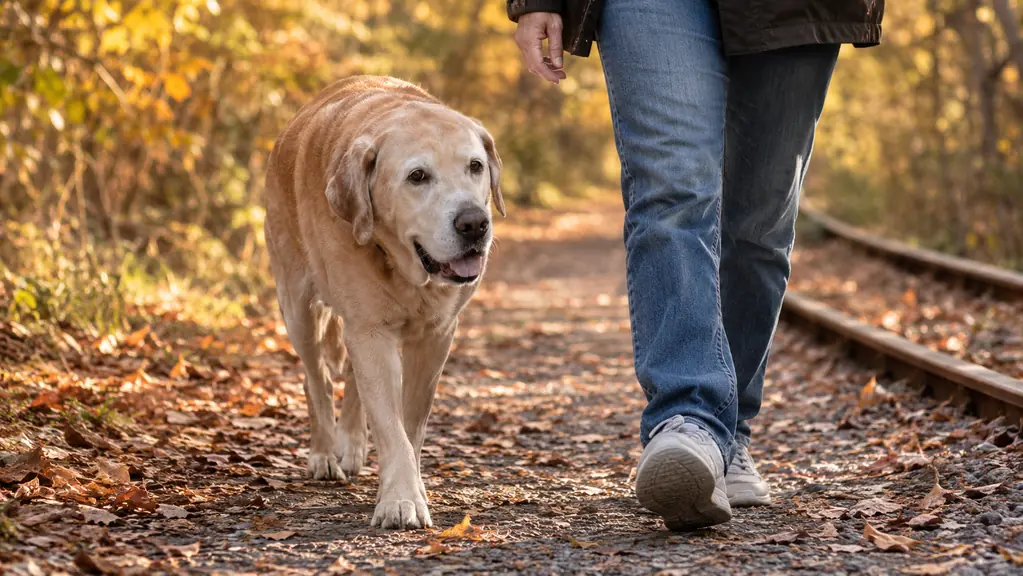
Our house is a one-story ranch. There are no indoor stairs. The steps I talk about are the four wooden ones off the back deck. Hattie goes down them steadily now and is still slow coming up. I do not rush her. On the rail trail, we went from about 45 minutes years ago to about 15 by September 2024, then back to about 25 by summer 2025. That is where we have stayed.
Weight is part of this too. Dr. Amsel asked us to keep Hattie under 70 pounds, and she has stayed at 68. That is not a dramatic story. It is just plain kibble and measured meals. Dan lifts her back end into the Subaru Outback now. She stopped jumping in during 2024 and never started again. No product changed that. We changed how we do it.
The walk itself is worth adjusting one turn at a time. When we were down to 15 minutes in the fall of 2024, I did not push it back up. I walked the same short stretch and let her set the pace, and I turned around where she told me to turn around, which was usually at the second bench. When she started pulling toward the third bench in the spring of 2025, that was her idea, not mine. Short and consistent beat long and occasional every time. If your dog is stiff, a 15 minute walk every day does more than a 45 minute walk on Saturday, and the dog will tell you when it is time to add the third bench.
What Else Helps
I added other things later, one at a time, months apart. Salmon oil came in January 2025 for her coat. Green lipped mussel powder came in April 2025. Hyaluronic acid came in August 2025. Turmeric came in January 2026, because winter mornings were her worst. I cannot prove which one did what. They overlap, and I am not going to pretend I ran a clean experiment. The VetIQ chew stayed the constant through all of it.
What else helps is boring and steady. Keep the dog lean. Keep the walking consistent, even if it is short. Keep the floors from being slippery. Watch the cold, wet days, because they are still Hattie's worst. And keep your vet in the loop. Dr. Amsel looked at every label before Hattie started it. He is the one who told me a supplement was reasonable to try and also told me it was not a cure. That is the balance I would want for any dog.
If you have room for one more habit, make it the morning look. Before I put the bowl down I watch Hattie get up off the carpet. It takes ten seconds and it tells me more than the clipboard line later will, because I see it happen instead of remembering it. That is where I noticed the difference first in December 2024, and it is where I would notice a change now if something turned the wrong way. A log is a record. The morning look is the reading.
By the second week of December 2024, the clipboard line changed from 'hesitated' to 'up on the second try.' That was the first thing that moved, and it is the only thing I will credit to the first product I tried.
Start With One Chew and One Honest Log
I cannot tell you VetIQ will do for your dog what it did for Hattie. I can tell you it is the first thing we tried, the one we never stopped, and the one I would start with again after a vet check. Give it six to eight weeks and write down what you actually see.
Amazon Check Today's Price on Amazon →