
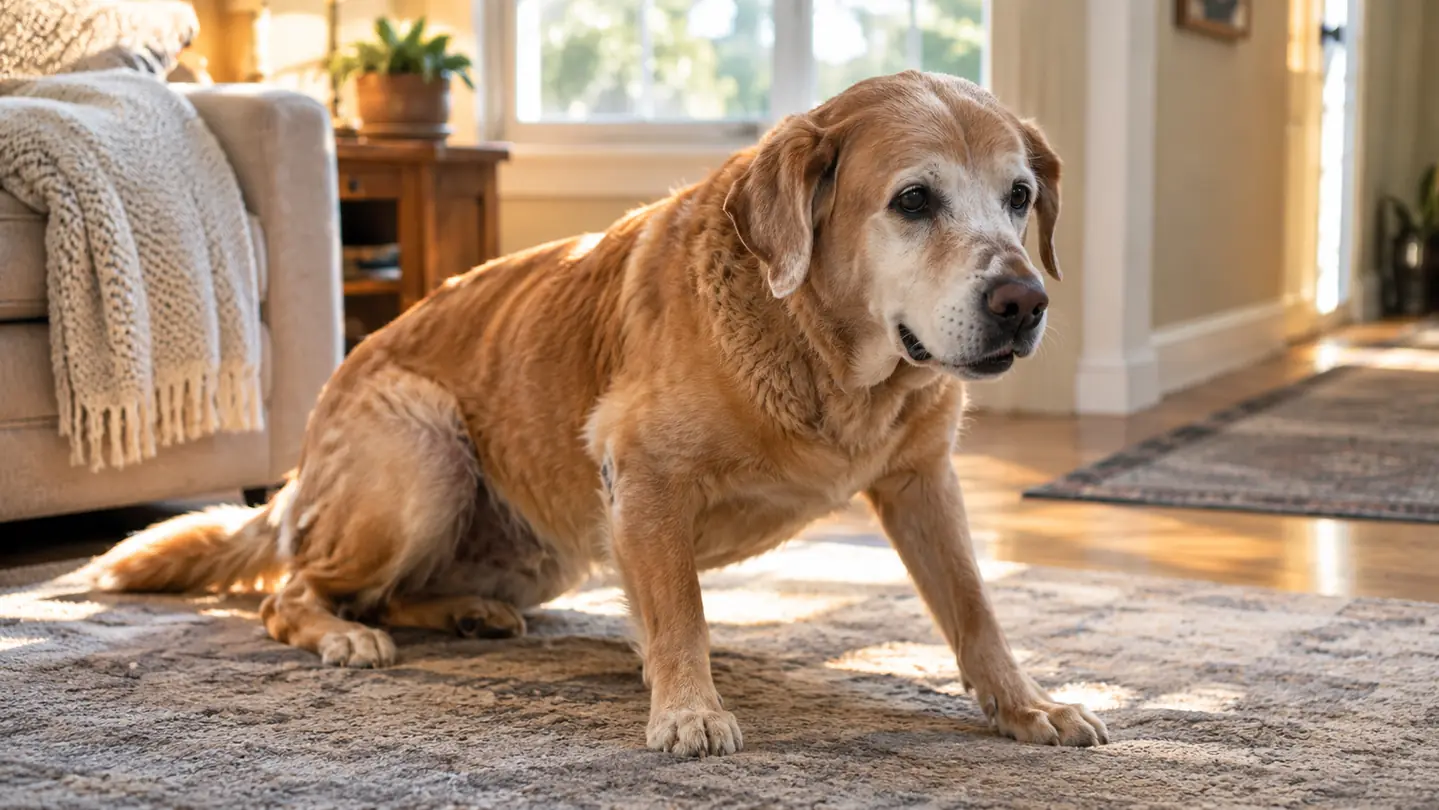
The first thing I noticed was not a limp. It was a pause. Hattie would get her front feet under her, stop, take one breath, and then push up off the living room carpet. She was nine the first time I saw it. By September 2024 she was ten years old, sixty eight pounds, and Dr. Amsel had X-rays showing arthritis in both hips, worse on the left. Nothing dramatic about it. Just a dog who had started to think about standing up before she did it.
Then I did what most people do, which is buy things. A glucosamine chew in October. Salmon oil in January. Green lipped mussel powder in April. I added them one at a time, months apart, so the clipboard on my kitchen counter had a chance to show me something, and two of the three earned their place. The fourth thing went into the bowl in August 2025 and it was a liquid. LubriSyn HA, an eight ounce bottle, poured over breakfast once a day. I almost skipped it. Hattie was already on three products and I could not see how a fourth was going to change anything. Dr. Amsel read the label and said it was fine to try. Here is how I gave it, in the order I would do it again.
The Fourth Thing on the Counter, Not the First
I added LubriSyn HA fifteen months ago, months after the glucosamine and the fish oil, and I would start it in the same place again. One bottle, one meal, five weeks of written lines before you decide anything.
Amazon Check Today's Price on Amazon →Step 1: Have your vet look at the dog and read the label before anything goes in the bowl
This is the boring step and it is the one I would not skip. Dr. Amsel has seen Hattie since she was a puppy. He already knew about the hips and about the left side being worse, because he took the X-rays himself. What I wanted from him was not a promise that anything would work. I wanted him to read the bottle and tell me whether it would fight with what she was already taking. He read the label, asked what she weighed that morning, and said to go ahead. Then he said the thing he always says, which is to keep her under seventy pounds.
If your dog is on prescription medication, or has a diagnosis with a long name, or is younger than a year, that conversation matters more, not less. I am not a veterinarian and I am not going to write like one. I taught high school physical education for thirty one years and coached cross country, and what that gave me is a habit of watching how a body moves. It did not give me pharmacology. Have the label read by the person who knows your dog's chart, and if they say no, that is your answer.
It is also worth asking out loud whether a liquid is the right form for your dog at all. For Hattie it was the only form left. She had already started eating around the chews, and she could pick a powder out of the kibble and leave it, and I was done with the small daily negotiation. A liquid goes onto the food and disappears into it. If your dog takes a chew happily and the chew is doing its job, you have no problem here and you should keep your money.
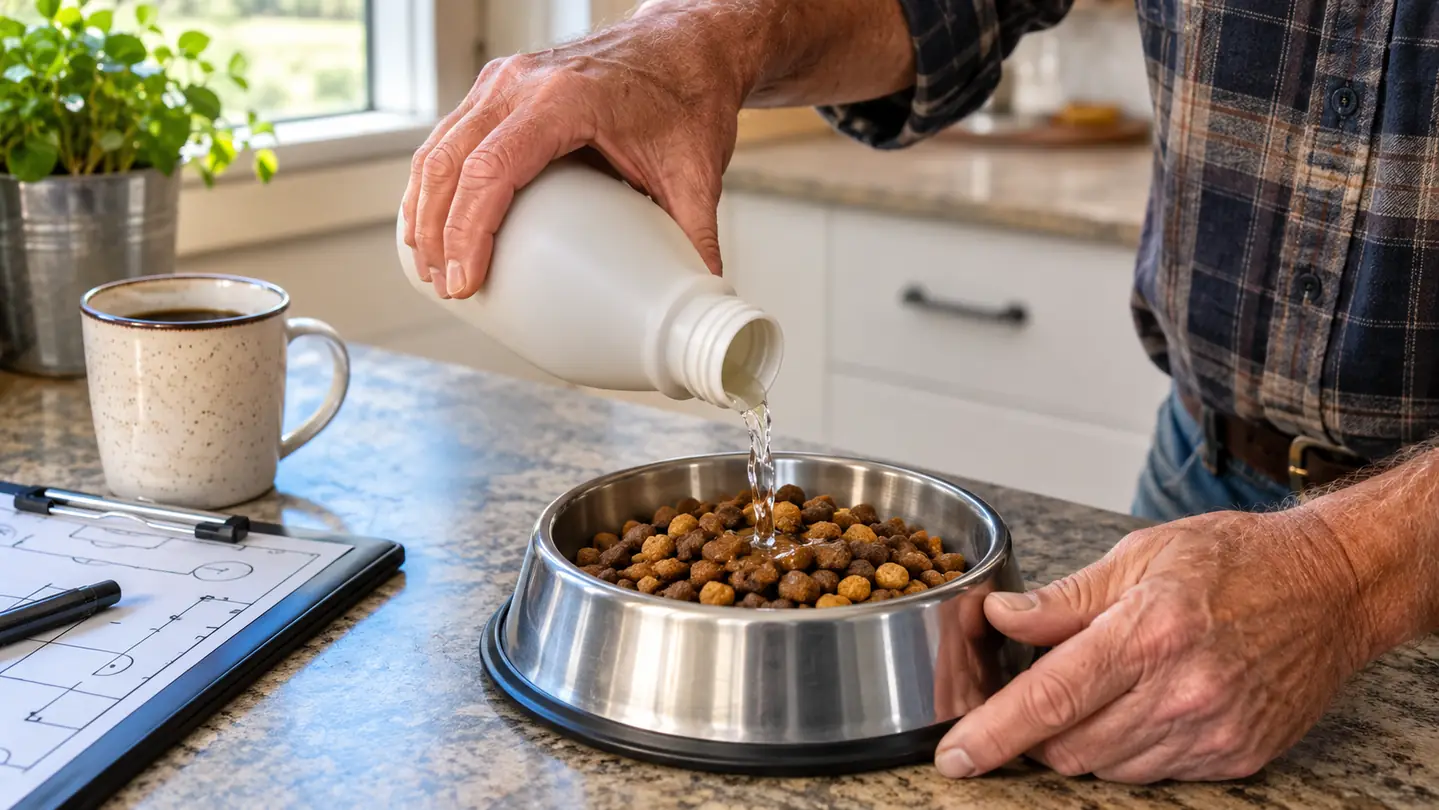
Step 2: Use the amount on the label for your dog's actual weight
The label gives an amount by weight and we used the amount for a sixty eight pound dog. What surprised me is how quickly the bottle empties. The listing says eight ounces is about two weeks for a forty pound dog. At sixty eight pounds it runs out closer to a week and a half. That is my one real complaint about LubriSyn, and it is a complaint about arithmetic, not about the product. Set a reminder the morning you open the bottle, because the bottle will not warn you and I have forgotten twice.
The bottle is eight ounces, two hundred thirty six milliliters, if you want to check what is in your hand against what the listing says. What comes out is a clear, slightly sweet liquid. There is nothing in it to argue with, which sounds like a small thing until you have spent a month negotiating with a dog who has learned to eat around a chew. The listing also says the formula is vegan, gluten free, and made in the USA in a GMP certified facility. I read all of that. None of it is the reason I kept buying it, but I read it.
I also measured once, with a kitchen spoon, so I knew what the right amount looked like in the bowl and not just on the label. It is a small volume. If you are eyeballing it you will pour more than you should, because more feels like helping. It is not helping. The label amount is the label amount, and the bottle empties fast enough without me speeding it up.
Step 3: Put it in the same meal, at the same time, every day
Breakfast is at seven in our house and dinner is at five. LubriSyn goes on breakfast, poured straight over the kibble, and the bowl goes down. The first morning I stood there braced for a fight. Hattie licked the bowl and looked up for more. That was the entire event. No pill pocket, no peanut butter, no holding her head still. Dan feeds her when I am out in the morning and the only instruction he needs is the amount and which meal, which is my test for any routine. If it takes two people and a procedure it will not survive a busy week, and a supplement that gets skipped is not a supplement.
It lives in the pantry with everything else. The listing does not ask for refrigeration and I have never put it in the fridge. The salmon oil is the one that lives in the refrigerator door, and that is a different product with a different label. Keeping the two straight took me about a week of opening the wrong door.
One more thing about timing, and this one matters more than people think. If your dog is already on other products, do not start the new one on the same day you change her food, or add a chew, or lengthen her walk. You will have no idea what did what. I started one thing at a time, months apart, and I still cannot prove which one did what. What I can do is point at a date on the clipboard and say what went into the bowl the week before it.

Step 4: Decide how you will know it worked before the first dose
This is the step people skip and then argue about online. Before the first bottle I set up the clipboard that already sits on my kitchen counter, and I wrote down three things, one line a day. How she got up in the morning. How she did on the four wooden steps off the back deck. How far we walked on the rail trail. Three things I could see with my own eyes. No rating out of ten. No mood. No guessing.
Here is why the lines matter. The listing says results may be visible in seven to fourteen days. I watched for that, and at two weeks I had nothing written down that looked different from the week before. If I had been working from memory I would have quit right there and told you it did nothing at all. The lines kept me honest in both directions. They stopped me from imagining an improvement, and they stopped me from writing off a small one.
The clipboard itself is nothing special. It is the same one I carried when I was coaching, with a sheet of paper clipped to it. What makes it work is that I fill in the line at the same time every morning, before breakfast, and I do not go back and edit last week. If you keep a running memory of how your dog did, you will remember the good days and the bad days will blur into the middle.
Step 5: Give it five weeks before you decide anything
At about five weeks the clipboard changed. Hattie came down the deck steps without the pause at the top. Not faster, exactly. Steadier. She put one foot down, then the next, and she did not stop to think between them. A stranger would not have noticed. I noticed because I had been watching that exact spot on those exact steps for a year.
Fifteen months later she is still on it and still steady on those four steps. She is not young again. She is still slow going up, cold wet mornings are still her worst, and nothing on my counter has made her run, jump, or get back into the cargo area on her own. That last part is the piece I would want a stranger to tell me, so I am telling you.
The other thing about waiting is that the change was small enough to miss if you were only watching the walk. The distance stayed about the same for months. What changed was the way she started and stopped, and the way she handled the deck steps. If your only measure is how far you go, you can miss the thing that actually changed.
What Else Helps
Weight, first, because it is free and it does more work than any bottle. Dr. Amsel asked us to keep her under seventy pounds and she has sat at sixty eight since 2024. Every joint product on the market is doing less for a heavy dog. That is the one lever I control every day without spending anything.
Walking, every day, including the short ones. We went from forty five minutes down to about fifteen by September 2024, back to about twenty five by the summer of 2025, and it has held there. On bad mornings we go to the end of the road and back. A stiff dog that stops moving gets stiffer, and then she moves less, and around it goes. Dr. Amsel was blunt about this and he was right.
The floor. We put rubber backed runners down the hall in 2024 because she slipped on the hardwood, and that was a safety decision, not a supplement decision. It cost less than any bottle on my counter. If your dog is slipping on a hard floor, fix the floor before you fix the bowl.
Her other four products. A glucosamine chew at breakfast, salmon oil at dinner, green lipped mussel at dinner, turmeric at dinner, and the hyaluronic acid at breakfast alongside the glucosamine. I am not going to tell you the liquid is the one that matters most, because I honestly do not know. All five are still in the rotation and none was ever stopped to test it, which is exactly why I keep saying I cannot rank them for you.
Sleep. She sleeps on the living room carpet and always has, so that is not a change anybody can credit. But a dog who rests well on a soft surface moves better in the morning than one who does not. There is no product in that answer, which is why nobody sells it and why I keep saying it.
And your vet, again. If the stiffness arrives with a yelp, a swollen joint, a refusal to eat, or a change you can date to a weekend rather than to a year, that is not a supplement question. That is a phone call. I have made that call twice and I was glad both times.
At two weeks I had nothing on the clipboard. At five weeks she came down the deck steps without the pause at the top. The pause was the whole reason I started.
Five Weeks of Lines on a Clipboard Beats Five Weeks of Hoping
If you are going to try it, try the version you can measure. One meal a day, the label amount for your dog's weight, three things written down. That is the entire method, and it works whether the answer turns out to be yes or no.
Amazon See Today's Price for LubriSyn HA →