
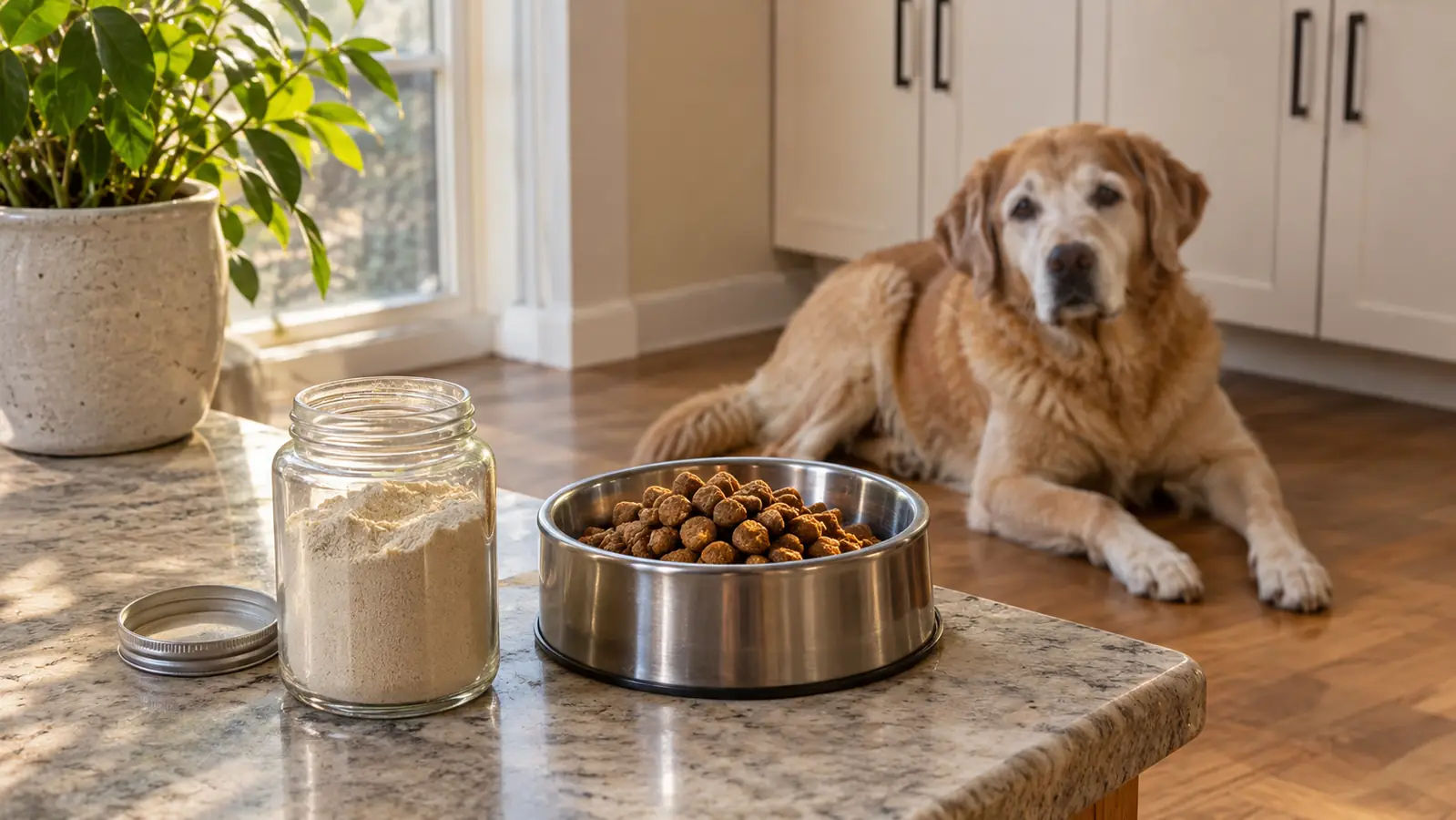
Hattie is a ten-year-old golden retriever, sixty-eight pounds, and she had been slowing down so gradually that I nearly missed it. She still wanted the walk. She just wanted a shorter one. In September 2024 Dr. Amsel put the X-rays up on the screen and showed me arthritis in both hips, worse on the left. We talked about surgery, injections and prescription pain medication, and we agreed to revisit all of it later. What we did instead was start one thing at a time and write down what happened. Green lipped mussel came third, in April 2025. Getting it into her took some figuring out, because she is not a dog who will eat anything you set in front of her.
That is what this is about. Super Snouts Joint Power is a plain powder, one ingredient, green lipped mussels, no fillers, and it comes in a 2.64 ounce jar with a small scoop. There is no chew to hide it in and no flavoring to carry it, which is exactly why a picky dog can turn it down. Hattie turned her nose up at it dry and ate it without complaint once I changed how I served it. The five steps below are the ones that made the difference, in the order they mattered.
The plain one-ingredient powder Hattie finishes at every dinner
Super Snouts Joint Power is 100 percent green lipped mussel with no fillers, in a 2.64 ounce jar that lasts a sixty-eight pound dog about three months. Read the label, check the current price, then take it to your own vet before the first scoop.
Amazon Check Today's Price on Amazon →Why a Plain Powder Suits a Picky Dog
One ingredient is either the best thing or the worst thing about a powder, depending on your dog. The label lists green lipped mussel and nothing else. The listing says the mussels are cold processed, and that the powder is meant to support the structural integrity of joints, ligaments, tendons and connective tissues, with natural omega-3 fatty acids alongside. I am not going to dress that up as more than it is. It is shellfish in a jar, and it either helps your dog's stiffness or it does not.
The jar itself is smaller than I expected, about three inches across and a little over three inches tall, and the whole thing weighs 3.84 ounces on my kitchen scale. At Hattie's weight it lasts close to three months. That is a long enough run to judge it and a long enough run to be careful about how you serve it, because you are going to be doing this every day for a while.
I did look at mussel chews before I bought anything. A chew brings flavoring and a binder and something to gnaw, and for a dog that will take a chew that is a perfectly good route. Hattie is the other kind. She inspects. A powder I can stir into what she already likes gives me one variable and no negotiation, and after two years of this I will take boring and controllable over clever every time.
Step 1: Ask Your Vet About the Shellfish Question First
Green lipped mussels are shellfish. That is the first thing I would say to anyone, and it is the first thing Dr. Amsel said to me. Hattie had never shown a reaction to anything in ten years, and he still wanted to go through her history before she started Super Snouts. If your dog has ever reacted to shellfish, or to a food you could never identify, this is a conversation to have before the first scoop rather than after it.
He also read the labels of everything she was already on, which by then was a glucosamine chew and a salmon oil. I brought the containers in and he went through them one at a time. That is not a step I would skip if your dog is on anything prescription, and it is not a step I would take a stranger's word on over the internet, mine included.
One more thing about timing. Do not start a new powder in a bad week. If your dog is having a rough stretch, or the weather has turned and everything is worse anyway, wait for ordinary days. You want a plain run of them, so that when the change shows up you can tell it was the powder and not a warm spell.
Step 2: Measure With the Scoop That Comes in the Jar
The scoop in the jar is small, smaller than any spoon in my kitchen drawer, and that is the point. The serving is dosed by weight, and at sixty-eight pounds Hattie gets three level scoops a day, which works out to 750 milligrams. The label carries the amounts for smaller dogs. For the first month I leveled each scoop against the rim of the jar, because a rounded scoop is easily double a level one and I wanted Tuesday to match Sunday.
I keep the scoop in the jar and the jar in the pantry, and I do not freehand it when I am running late. If you own a kitchen scale, weigh three level scoops once so you know what the dose actually looks like in your hand. If you do not, level scoops and the scoop that came with the jar will do. What I would not do is use a tablespoon, because tablespoons differ and then the dose stops being a dose.
Decide in advance what happens on a missed day, too. I do not double the next one. Hattie gets her normal three scoops and the missed day is simply gone. Doubling to catch up is how people end up guessing at what worked, and the whole reason I can tell you anything useful about Super Snouts is that the number stayed the same for a year and a half.
Step 3: Stir It Into the Wet Part of a Meal, Not On Top of Dry Kibble
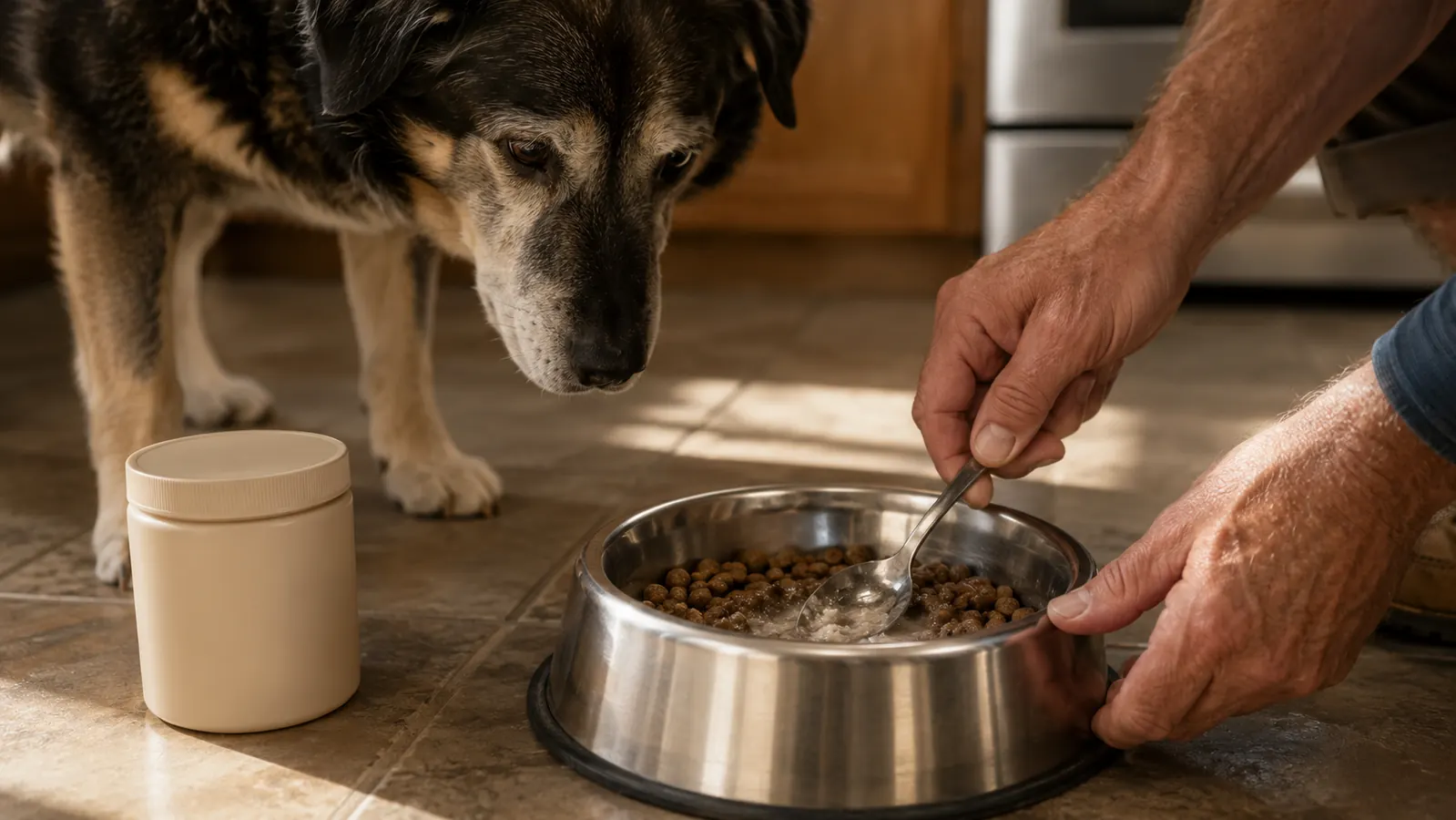
This is the step that turned Hattie around, and it took me two weeks to get there. Sprinkled dry on top of kibble, the powder sifts down through the bowl and settles at the bottom. A dog who licks the top of her dinner leaves most of it behind. I know because I checked the bowl, more than once, feeling foolish.
What worked was a spoonful of water stirred through her dinner until the powder turned into a thin paste that clings to the kibble. She eats at five and the whole job takes ten seconds. A spoonful of canned food would do the same thing, but keep it small. Dr. Amsel asked us to keep Hattie under seventy pounds and she has held at sixty-eight, and I was not going to undo that with a topping.
From the human side, it smells. It is shellfish and it is strong, and I do not enjoy opening the jar. Hattie has never once hesitated over it and Dan has learned to stand upwind. If your dog is fussier than mine, start with half the amount mixed well into the wet part of the meal and build to the full serving across a week, so the smell is familiar before the volume is.
About six weeks in, the clipboard said she had stopped dragging on the last stretch of the walk. That is the whole result, and I will take it.
Step 4: Same Meal, Same Time, One Change at a Time
Hattie gets Super Snouts at dinner, five o'clock, the same meal every day. Not because dinner is better than breakfast, but because a dose you can count on beats a dose that gets split, forgotten or argued about. Dan handles a meal now and then when I am out, so the jar and the scoop sit where he can see them and the number is written on a card beside it.
One change at a time is the harder half of this step. I added her five supplements months apart, one at a time, and I will tell you plainly that it means I cannot prove which one did what. What I can tell you is that nothing got lost in the noise and nothing got blamed on the wrong thing. If you already give a joint chew, add the mussel powder and hold everything else steady for six weeks.
Six weeks is also about how long a jar of habits takes to form. By then you are not measuring anymore, you are just making dinner. That is the point where most people stop noticing, which is precisely why the clipboard matters more in week five than it did in week one.
Step 5: Judge It on What You Wrote Down, at Six Weeks
There is a coach's clipboard on my kitchen counter and it has one line a day: how she got up in the morning, how she did on the four wooden steps off the back deck, how far we walked. Three things, thirty seconds. It is the only reason I can tell you what happened instead of what I hoped happened.
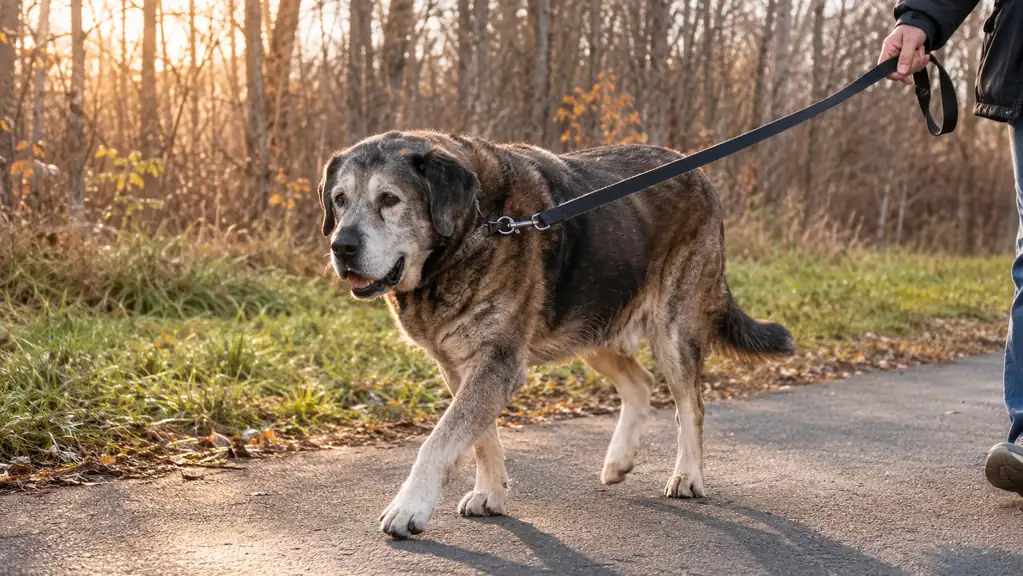
At about six weeks I could see it. She stopped dragging on the last stretch of the rail trail. Not dramatic, and not something I would have trusted from memory alone. Going down the deck steps was steady. Coming up was still slow. Cold, wet mornings were still her worst. No product has made her run, and I would not believe anyone who told me one did.
Give it six weeks before you decide anything and eight to twelve before you give up. If nothing has changed by then, tell your vet what you tried and for how long, and move on rather than keep buying a jar out of habit. There is no harm in stopping something that is not doing a thing.
What Else Helps
The powder was never the whole answer, and I would be doing you a disservice to pretend otherwise. Weight is the one Dr. Amsel comes back to at every visit. Hattie at sixty-eight pounds moves differently than Hattie would at seventy-five, and keeping her there has done more than any single item in the pantry. Walks matter too, and consistency matters more than distance. Twenty-five minutes on the same rail trail most days serves her better than one long outing on a Saturday.
Footing is the thing nobody mentions until their dog slips. We have hardwood in the hall and kitchen, and in 2024 Hattie went down on it, so there are rubber-backed runners down the hall now and they have stayed. The four steps off the back deck get a hand on her collar going down on wet days, not because she cannot manage them but because I would rather she did not have to think about it.
And keep the vet in the loop, which is not the same as asking permission. Dr. Amsel rechecks her hips, watches her walk into the room, and asks what is still in the rotation. That conversation is where I would start if you are staring at a wall of joint products and cannot tell them apart. Bring the labels. He read every one of ours.
Who This Is For
This is for the owner of an older dog who has started to hesitate, the one who still wants the walk but turns back early, and who has already been through the chews with mixed results. It suits a dog who eats reasonably well and a person willing to do the same small thing every day for two months. It does not suit a dog with a shellfish allergy, a dog in the middle of a medication change, or a household where nobody wants to keep a note.
It is also not a substitute for a diagnosis. Stiffness in a ten-year-old dog has several possible causes and arthritis is only one of them. Hattie's hips were X-rayed before any of this started. If your dog's have not been, that comes first. Everything here is one owner's log and one vet's read of a label, not a medical instruction.
One jar, one dog, one line on the clipboard each day
Six weeks of level scoops stirred into dinner is enough to know. Super Snouts Joint Power is the version that got eaten in this house, and a coach's clipboard is what told me it was working.
Amazon Check Today's Price on Amazon →