

There is a moment when you stop reading labels and start reading your dog. Ours came in January 2026, on a morning cold enough that Hattie stood at the top of the four wooden steps off our back deck and thought about it. Not refused. Thought about it. She was ten years old, sixty-eight pounds, with arthritis in both hips and worse on the left, and by then she had been on three joint products, added one at a time, months apart. She was better than she had been in September 2024. She was also slower in the cold than she was in July, and I had run out of things to try that did not involve a prescription.
That winter I added turmeric. Not as a replacement for anything, and not because I had read something dramatic. I added it because Dr. Amsel, who has been Hattie's vet since she was a puppy, went through the label with me and did not object, and because I keep a coach's clipboard on the kitchen counter with one line a day on it, and I wanted to see what the lines would say. The one we landed on was Amazing Turmeric for Dogs from Amazing Nutritionals, a bacon and beef liver flavored chewable tablet, 120 to the bottle. I am not a veterinarian and I am not going to write like one. What follows is how I worked it into Hattie's day, in five steps, and what I would tell you to do differently in your own kitchen.
The Turmeric That Has Been in Hattie's Dinner Since January
Bacon and beef liver flavored chewable tablets, 120 to the bottle, about 40 days at three a day for a dog her size. Dr. Amsel read the label before she started it, and so should your vet.
Amazon Check Today's Price on Amazon →Step 1: Have Your Vet Read the Label Before Your Dog Does
Hattie was already on three things when I started looking at turmeric. A glucosamine chew at breakfast, a salmon oil and a green lipped mussel powder at dinner, and a hyaluronic acid liquid poured over her morning meal. Adding a fourth felt like a lot to ask of one dog's stomach. So before I opened anything, I put the label in front of Dr. Amsel and asked a plain question: is there anything here that fights with what she is already getting?
What he checked was not dramatic. He looked at how the amounts stacked against the other three, whether it would land on a full stomach or an empty one, and whether her history gave him any reason to say no. He said it was fine to try. That is the whole of what I know. I am not qualified to tell you what is safe for your dog, and a listing page is not qualified either. Your vet knows your dog's bloodwork, your dog's liver, and your dog's other pills.
The second thing I asked him was what to expect. He gave me the honest answer, which is that some dogs seem to move a little easier on turmeric and some do not, that it is not a pain medication, and that I should not stop anything else to make room for it. If your vet says no, the answer is no. There are better ways to spend a Saturday morning than arguing with a professional who went to school for this.
Step 2: Choose a Form Your Dog Will Take Without a Discussion
Turmeric comes four ways. A loose powder you measure and stir in. A capsule you can hide or open. A soft chew. And a tablet. They all get the active ingredient into the bowl and they fail in different places. Powder fails when you get tired of measuring. Capsules fail when your dog learns to eat around them. Soft chews fail when your dog decides after two weeks that this particular chew is not food. The form that survives is the one your dog takes without you having to negotiate.
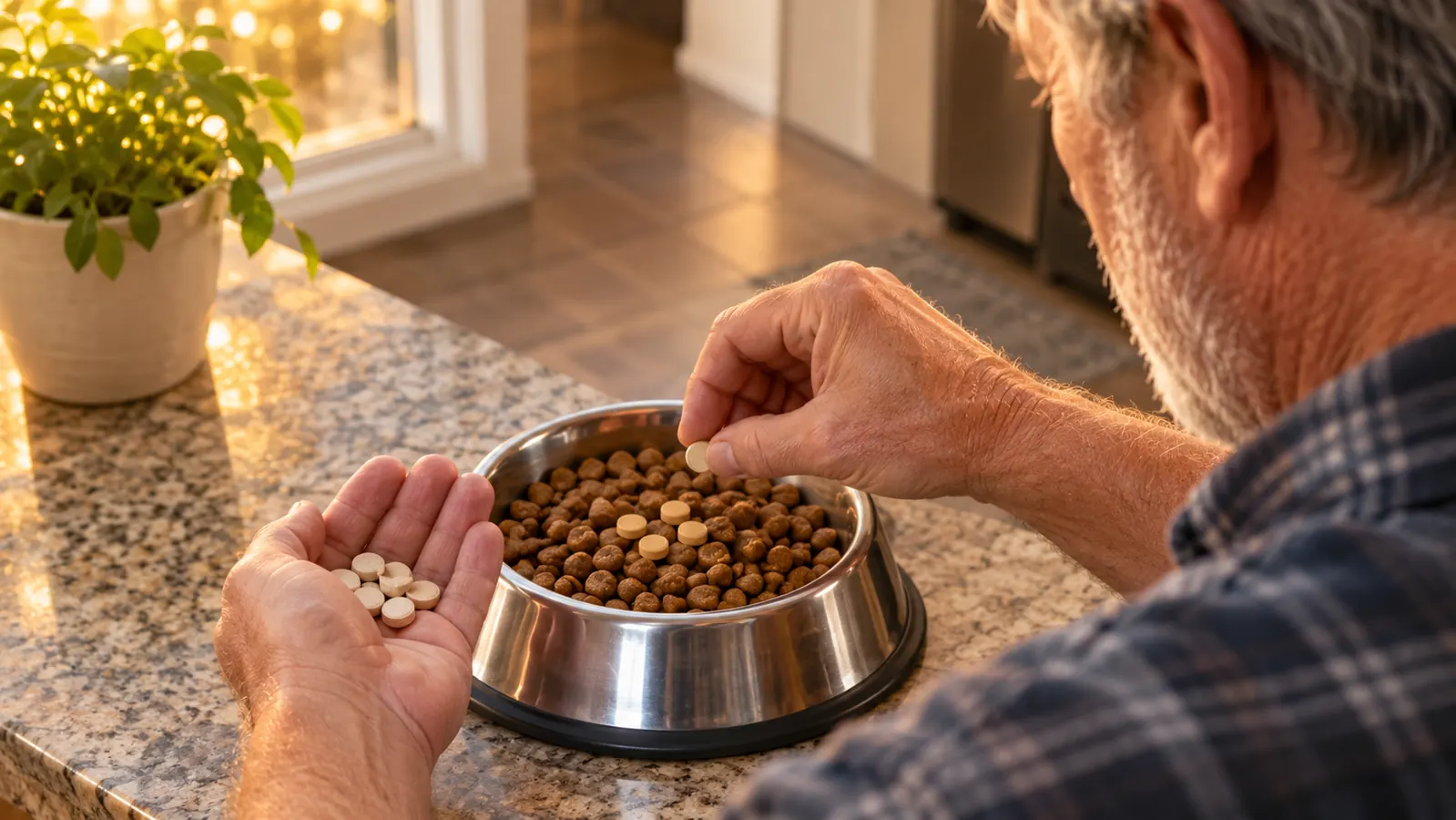
We used a small chewable tablet from Amazing Nutritionals, bacon and beef liver flavored, 120 to the bottle. The listing says gluten free, peanut free and soy free, made in America, no byproducts. I care less about the wording on the page and more about the fact that Hattie takes hers off the top of a full dinner bowl and chews it. No cheese, no peanut butter, no holding her mouth closed. That matters more than it sounds like it should, because you are going to do this every day for months, and any friction you build in at the start you will still be paying for in the spring.
If your dog is a gulper, any form works. If your dog is a sniffer who picks the kibble out from around things, the tablet is the version that leaves the least behind. Small and easy to chew is what the listing promises, and ten months in she still takes it as though it were part of dinner, which it now is.
Step 3: Start Below the Label and Step Up
The label amount for a dog Hattie's size is three tablets a day. I did not start there. I started at one tablet a day for three days, then two, then three, which is where we have stayed since January 2026. The reason is not complicated. If a dog is going to have a stomach problem with something new, I would rather find out on one tablet than on three, and I would rather find out in a week than in a month.
Nothing happened. No loose stool, no vomiting, no change in appetite, no refusal at the bowl. She has never had a bad reaction to any of the five things she takes and turmeric did not break the streak. If it had gone the other way I would have stopped, called Dr. Amsel, and that would have been the end of it. There is no prize for pushing a ten year old dog through a stomach upset to prove you were right about a supplement.
Three tablets a day means the bottle runs out in about 40 days at her weight. That is the number that decides whether a thing stays in the routine. Roughly a bottle a month is a rhythm I can hold, and a daily routine only works if the supply side is boring. Anything that asks me to reorder on a different schedule every time is a thing that quietly falls out of the rotation by March.
At two weeks I saw nothing. At about six weeks I thought the cold mornings were a little easier. I cannot say for sure, and I am not going to pretend otherwise.

Step 4: Hang It on a Meal You Already Serve
Our day looks like this. Breakfast is the glucosamine chew and the hyaluronic acid. Dinner is the salmon oil, the green lipped mussel powder, and three turmeric tablets from Amazing Nutritionals. I did not design that schedule for elegance. I designed it so nothing has to be remembered separately. There is one rule in this house: food goes down at seven and at five, and whatever is going into that meal goes into that meal.
Turmeric landed at dinner for a practical reason. Dan handles dinner two or three nights a week when I am out, and three tablets set beside a bowl is a thing he can do without a briefing. A powder, a scoop and a specific number of scoops is a phone call. The simpler the action, the more likely it survives a change in who is doing it.
Whatever meal you pick, pick one and stay on it. The point is not the hour on the clock. The point is that the tablet goes in the same slot every day so the only thing you have to track is whether your dog is doing better, not whether you gave it. The clipboard handles the rest.
Step 5: Give It Six Weeks and Write Down What You See
This is the step I would argue with you about. Not the turmeric. The writing down. I keep a coach's clipboard on the kitchen counter and one line a day goes onto it: how Hattie got up in the morning, how she did on the four steps off the back deck, and how far we walked. That is all. It takes fifteen seconds. It is also the only reason I can tell you anything true about the last ten months, because memory is a flatterer. By the time you have spent a bottle on something, you want it to have worked.
What the lines say is this. At two weeks, nothing. I looked and there was nothing to see. At about six weeks, the cold mornings seemed a little easier. She was getting up off the floor with less of a pause. That is a modest thing and it is a thing I cannot prove, because by then she was on four other products and I could not tell you which one moved which needle. It might have been the turmeric. It might have been the accumulation of all of it. I am not going to claim more than the clipboard shows.
What the lines also show is what did not happen. She does not run. She does not jump into the back of the Outback, and she has not since 2024, and Dan still lifts her back end in. She is still slow coming up the deck steps. She is ten years old with arthritis in both hips, and no chewable tablet on any shelf is going to undo that. Anyone who tells you otherwise is selling something, and you should read their label twice before you read their promises once.
What Else Helps
Weight is the lever I would pull before anything else. Dr. Amsel asked us to keep Hattie under seventy pounds. She has sat at sixty-eight for two years, and I weigh her on the same scale at the same visit every time so the number means something. Every extra pound on a dog with two bad hips is a pound that comes down on the hips every time she stands up. That is not a supplement question. It is a measuring cup question.
The other half of it is the floor and the steps. In 2024 Hattie slipped on the hardwood in the hall and it scared me enough that we put rubber backed runners down from the kitchen to the front room. She has not slipped since. The four wooden steps off the back deck are the same four steps they have always been, and we still go down them slowly, one at a time, with me on the downhill side. Nobody sells you that. It costs less than a bottle of anything and it is the reason I can still get her out the door on a wet morning.
The walks matter too, and the honest number is about twenty-five minutes on the rail trail near the house. Years ago it was forty-five. In September 2024 it was fifteen. Twenty-five is where we have been since the summer of 2025 and it has held. I do not push past it on a cold day to prove a point. A retired coach will tell you the same thing about a tired athlete: the workout that gets done tomorrow beats the one that gets overdone today. On the days that are cold and wet, which are still her worst, we go short and we go anyway.
One last thing and then I will get out of your way. Turmeric is not a pain reliever and it is not a substitute for your vet. If your dog is limping badly, holding a leg up, or has stopped eating, that is a phone call, not a supplement. Hattie is not on prescription pain medication, and it was discussed as something to revisit later. That conversation belongs to you and your vet, not to a review from a woman with a clipboard.
She is ten years old with arthritis in both hips. No chewable tablet on any shelf is going to undo that, and I am not going to tell you it did.
One Tablet With Dinner, Six Weeks to Know
Bacon and beef liver flavored chewable tablets, 120 to the bottle, about 40 days at three a day for a dog Hattie's size. Start at one, step up slowly, and write down what you see.
Amazon Check Today's Price on Amazon →