
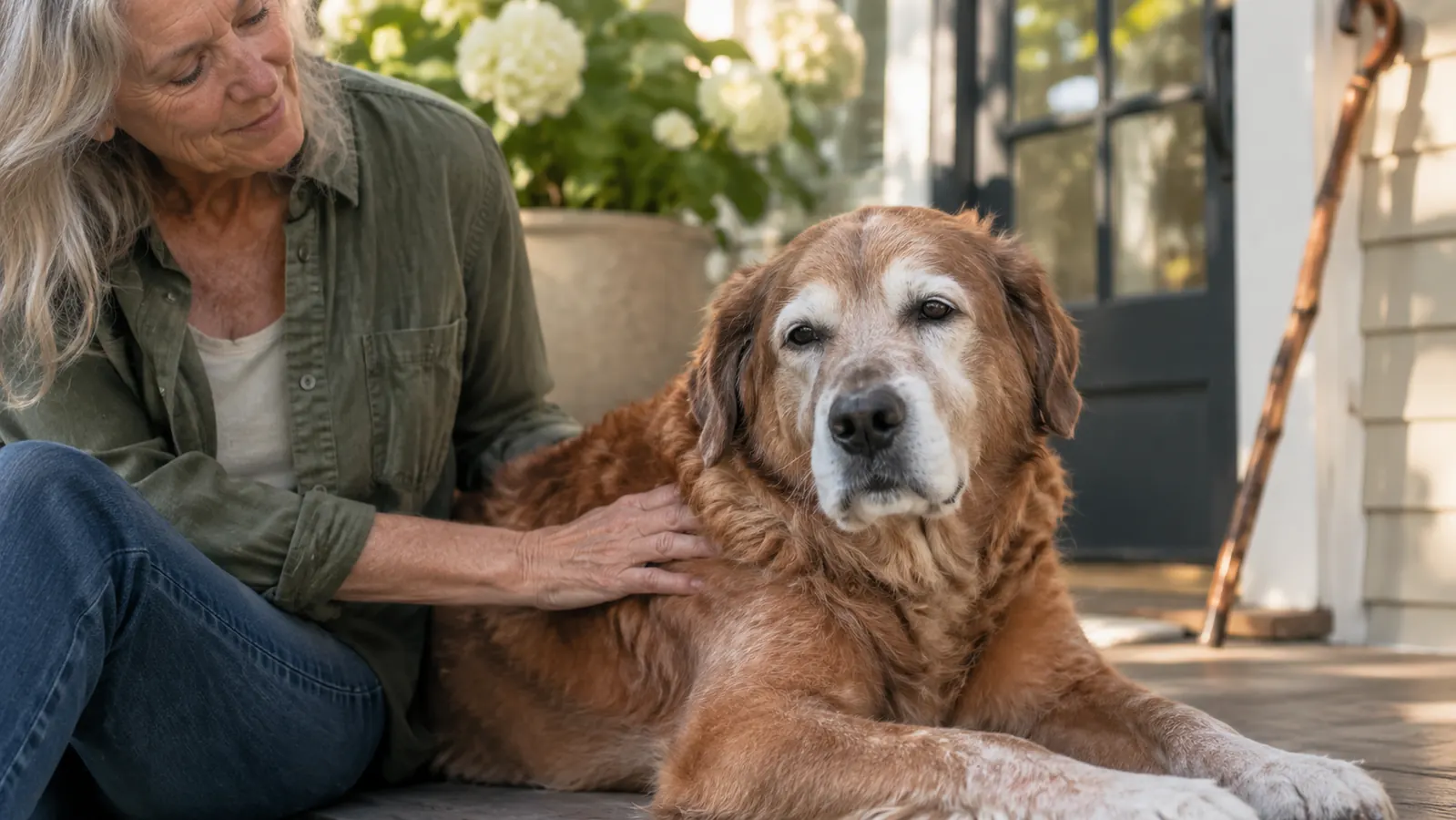
Hattie, our golden retriever, was 10 in September 2024 when the X-rays showed arthritis in both hips, worse on the left. She weighed 68 pounds, which is where Dr. Amsel wanted her, and she had started hesitating before she got up from the floor. I am Joanne Fitzgerald. I taught high school PE for 31 years and coached cross country, and I am not a veterinarian. What I know is how a body moves, and what I know how to do is write it down.
That fall I stood in a pet store aisle and looked at a wall of joint products. Hattie was already on VetIQ Maximum Strength Hip and Joint chews, which we started in October 2024 on Dr. Amsel's suggestion. In January 2025 I added Natural Dog Company Wild Alaskan Salmon Oil to her dinner. This is the how-to I wish someone had handed me then: one change at a time, a vet who reads the label, a measured serving, and a clipboard that tells the truth after eight weeks.
I am writing this as a dog owner, not as a clinic. Hattie has arthritis in both hips, she still walks every day, and she is not cured. If you are looking for a promise that a bottle will make your dog young again, I cannot give you one. If you want the steps I actually used, they are below.
The Fish Oil That Made It Into Her Dinner Routine
Natural Dog Company Wild Alaskan Salmon Oil is a liquid topper with a pump, 16 ounces, and two pumps go over Hattie's kibble at 5 p.m. Dr. Amsel read the label first. That is the whole reason it stayed.
Amazon See the Salmon Oil on Amazon →Step 1: Ask Your Vet Before You Pour Anything
I put the Natural Dog Company bottle on Dr. Amsel's exam table before Hattie ever tasted it. He read the ingredient panel, asked about her weight and her stool, and told me it was fine to try. I am not passing that along as a green light for your dog. I am passing it along as the order of operations. Your vet knows your dog's kidneys, pancreas, medications, and allergies. I know Hattie.
There is a reason I do this with every supplement. Hattie already had VetIQ in her breakfast. Later she would add a green lipped mussel powder, a hyaluronic acid liquid, and a turmeric chew. If I had started all of them in one week and she had a bad night, I would have had no idea which one to stop. One at a time is slower. It is also the only way the clipboard means anything.
Bring the actual bottle or container to the appointment, not a photo of the front. The back is where the amounts and the ingredients are. Dr. Amsel checked the label on the Natural Dog Company bottle and the labels on the others before any of them went into her bowl. He also confirmed she had no shellfish allergy before the mussel powder, which is a separate conversation but the same habit.
Step 2: Pick a Form You Will Actually Use Every Day
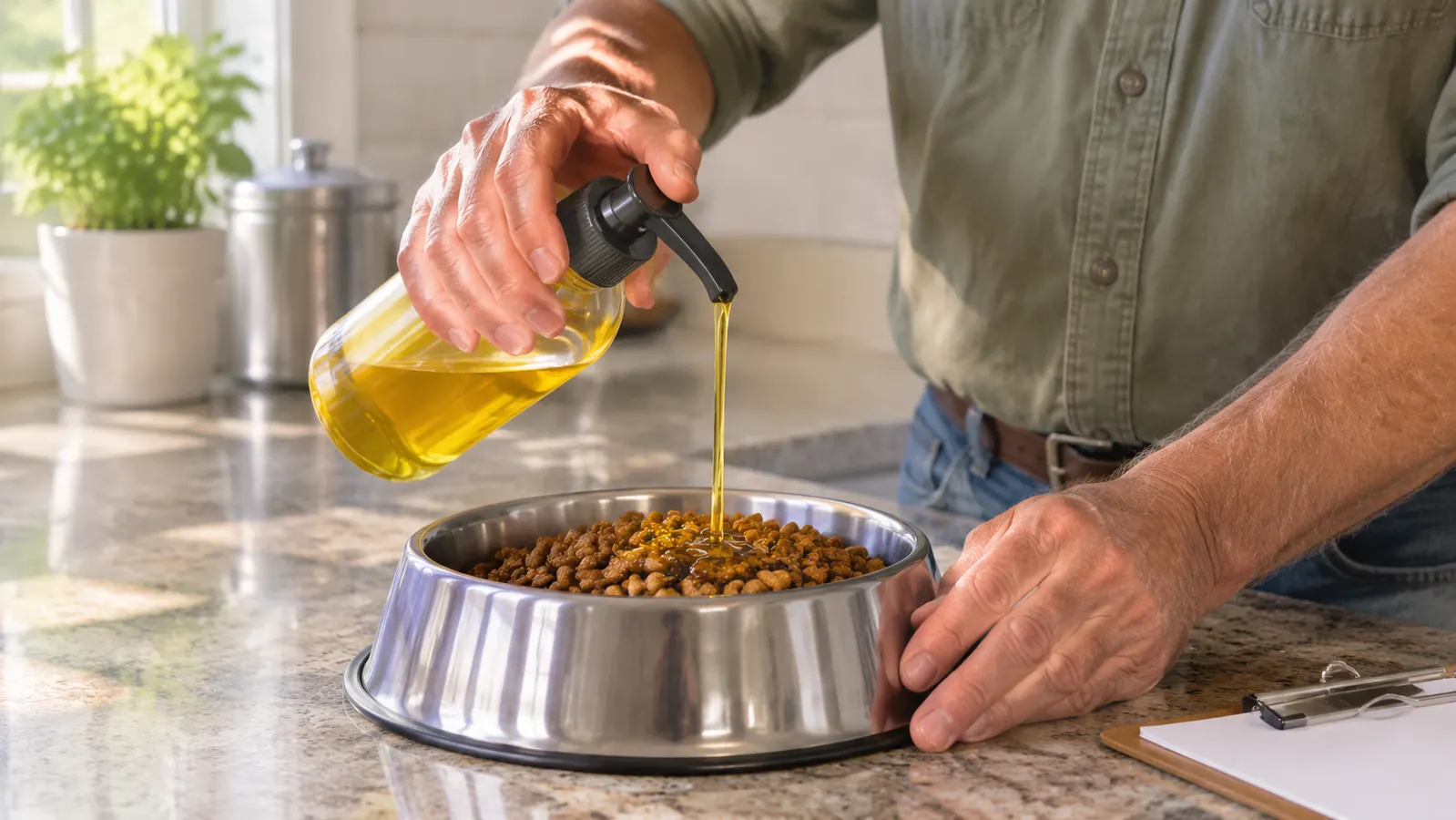
There are chews, powders, and liquids. I have used all three with Hattie. The Natural Dog Company Wild Alaskan Salmon Oil is a liquid in a 16 ounce bottle with a pump. The listing describes it as a salmon and pollock oil topper that pumps directly onto meals. That matters if your dog is a fast eater who inhales kibble, because there is nothing to hide and nothing to refuse.
The bottle is 2.5 inches square and 8 inches tall, so it stands in the refrigerator door without taking a shelf. I keep it there after opening, which is my choice. The label says a cool, dry place. It smells like fish. Hattie does not care. Dan does.
I picked the liquid because Hattie is not a picky dog, but she is a fast one. A pump over dinner takes me three seconds. A chew takes longer only because I wait to see that she chewed it. If your dog turns his nose up at liquid, a chew may be the better form. The best form is the one you will actually give at the same time every day.
One more thing about form: a liquid is easy to adjust if your vet changes the amount. You can add a pump or stop at one. A chew is not as flexible once it is in the bowl. That is not a reason to choose liquid for every dog. It is a reason I chose it for Hattie, who was already taking a chew at breakfast and a powder at dinner.
Step 3: Set the Amount for Your Dog's Weight and Write It Down
At 68 pounds, Hattie gets two pumps over dinner. That is our number, settled with Dr. Amsel, and I wrote it on the clipboard so Dan gives the same amount when he feeds her. Your dog's number may be different. Do not take mine. Use the amount your vet confirms for your dog's weight and the product you bought.
This is where a lot of people go wrong with a liquid. They eyeball a squirt, or they let the bottle glug. A pump is more consistent. I pump twice into the same spot on her kibble and stir it once with a spoon. If you are switching from a chew to a liquid, write the date on the clipboard. You will want it later when you are trying to remember when the change started.
I also wrote down what she weighed that week. Hattie has stayed at 68 pounds since Dr. Amsel asked us to keep her under 70. Weight is part of joint support. It is not a supplement, but it is not nothing either. A dog carrying extra weight is asking more of sore hips, and no oil changes that math.
If your dog is small, the amount will be smaller. If your dog is large, it will be more. That sounds obvious, and then people free pour. Use the pump, count it, and write it down. The pump is the only reason I can tell you two pumps instead of a splash.
Step 4: Put It on the Same Meal at the Same Time
Hattie eats breakfast at 7 and dinner at 5. The salmon oil goes over dinner. Breakfast already has VetIQ and LubriSyn. Dinner has the Natural Dog Company oil, the green lipped mussel powder, and the turmeric tablet. I did not put the oil in the morning because I wanted one meal to stay simple while I watched for changes.
The pump goes directly onto the kibble. I stir it once so it is not sitting in one spot. If your dog is a gulper, watch the first few meals. Hattie never had a bad reaction to any of the five things she takes, but I still watched. A new food topper is a change, and changes are worth noticing.
Dan feeds her when I am out. The clipboard line says two pumps, dinner. He does not have to guess. That is the whole system. If you live with someone else, write the amount where they will see it. If you live alone, write it anyway, because you will forget which day you started.
I keep the bottle where I can reach it without moving three things. That is not a small detail. If the supplement is behind the milk and the leftovers, it gets skipped. The refrigerator door works for us. A pantry shelf would work too, as long as it is cool and dry and you actually open it at dinner.
Step 5: Give It Eight Weeks and Judge by Notes, Not by Hope
I added the Natural Dog Company oil in January 2025. I wanted it to be the thing that fixed her hips. It was not. At eight weeks I could not point to one joint change on the clipboard. What I could point to was her coat. It was shinier and less flaky. That is a real change. It is just not the change I was hoping for.
The label lists EPA and DHA, omega 3 and omega 6, and it lists joint health among the benefits. That is why I tried it. A listing is not a promise for your dog. I have read enough labels to know that the same word can mean a lot or a little depending on the dog, the dose, and the rest of the routine.
I kept it because Dr. Amsel recommended it and because the coat result was real. I am not going to tell you it did nothing for her joints. I am telling you I could not prove it did. Hattie was also on VetIQ by then, and later she added the mussel powder, the hyaluronic acid, and the turmeric. Because they overlap, I cannot prove which one did what. Anyone who tells you they can separate five supplements given together is guessing.
Eight weeks is long enough to see a coat change and long enough to know whether your dog will eat it. It is not long enough to know everything. If your dog gets worse, stops eating, or has stomach trouble, stop and call your vet. Do not wait for the eight week mark because a stranger on the internet told you to.
What Else Helps
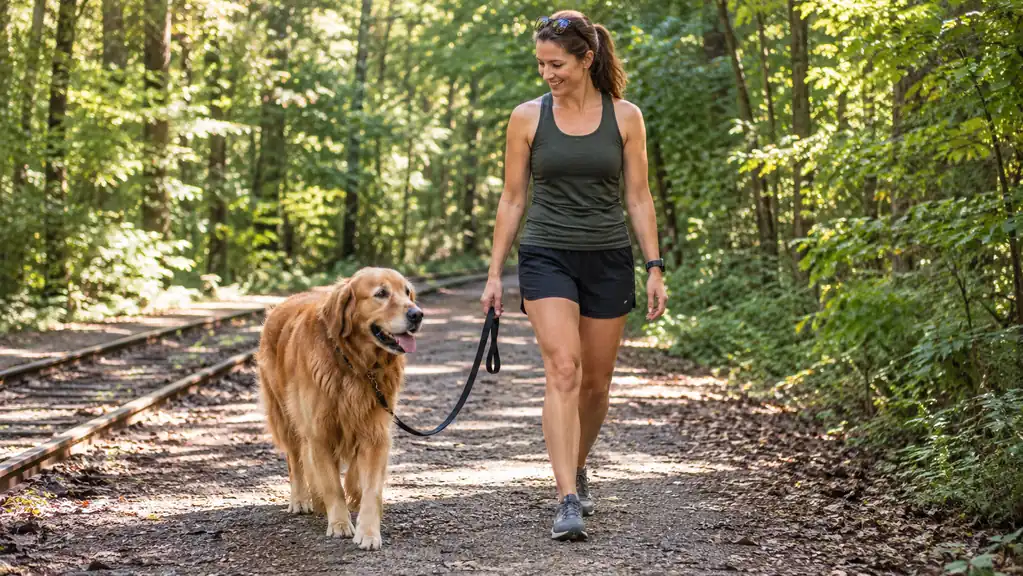
The oil is one line on the clipboard. The rest of the page matters more. Hattie was 10 at that first X-ray. She has arthritis in both hips. She still walks every day, about 25 minutes on the rail trail. That is down from 45 minutes years ago and up from 15 in September 2024. The walk is not optional. Dr. Amsel told us early that a dog who stops moving gets stiffer, and I believed him.
We have a one story ranch, so there are no indoor stairs. The four wooden steps off the back deck are the test. She goes down steadily now and is still slow coming up. We put rubber backed runners in the hall in 2024 after she slipped on the hardwood. We did not buy a ramp or a sling. Dan lifts her back end into the Subaru Outback. That is our house, not a prescription for yours.
If you are trying to help a dog with joint issues, keep the weight where your vet wants it, keep the walks short and regular, and make the floors less slippery. Then add one supplement at a time and write down what you see. The Natural Dog Company oil is part of our routine. It is not the whole routine.
I also keep the same food. Hattie eats plain dry kibble, breakfast at 7 and dinner at 5. I did not switch her food when I added the oil. If you change food and add a supplement in the same week, you will not know which one caused the good or the bad. I learned that from coaching, not from a bottle. Change one thing, watch it, then change the next.
The clipboard showed no joint change I could point to from the salmon oil. It showed a shinier coat at about eight weeks. I will take an honest nothing over a story I talked myself into.
If You Want the Same Bottle We Use at 5 p.m.
Natural Dog Company Wild Alaskan Salmon Oil comes in a 16 ounce bottle with a pump. Hattie gets two pumps over dinner. Dr. Amsel read the label first, and I would do that again for any dog.
Amazon See the Salmon Oil on Amazon →